TLDR
- MTG proxy cards become off-center when the printed artwork and the cutting equipment do not align perfectly.
- Narrow, symmetrical borders can make a shift of only 0.5 mm look much worse than it is.
- Measure the left, right, top, and bottom borders before deciding whether a card is defective.
- Contact the seller when the shift repeatedly exceeds about 1 mm, exposes an unprinted edge, affects important content, or varies severely across the order.
- A miscut may be the printer’s responsibility, but an improperly prepared file may not qualify for a free reprint.
If you are trying to understand why MTG proxy cards are off-center, the answer is usually not that the card was printed crooked in the ordinary sense. The problem is normally a small difference between where the artwork was printed and where the sheet was eventually cut.
Commercial printing equipment is precise, but it is not perfectly motionless. Sheets shift. Cutting equipment has tolerances. Printed images can move slightly relative to the trim line. On a borderless design, that movement may be nearly invisible. On an MTG-style card with a narrow black border, it can look as if the whole card slid sideways.
This guide explains how to determine whether the problem is normal production variation, a poorly prepared image, or a defect worth reporting.
Why MTG Proxy Cards Are Off-Center
Most professionally printed proxy cards begin as part of a larger sheet containing multiple cards. The sheet is printed first and cut afterward.
The intended cut position is called the trim line. Any difference between the intended trim line and the actual cut can make the artwork appear off-center. Printers often call this movement drift, registration variation, or cutting variation.
Several things can cause it:
- The printed sheet moved slightly before cutting.
- The cutting equipment was aligned differently from the printed image.
- The sheet rotated slightly, producing a diagonal or skewed cut.
- The artwork was already off-center inside the uploaded file.
- The design did not include enough bleed.
- The card front and back were not aligned equally.
- The card itself was cut to the wrong dimensions.
A small amount of movement is expected in most commercial production. The question is whether the movement is minor, visually disruptive, or severe enough to affect playability and appearance.
Why Narrow Borders Make Small Errors Obvious
Borders act like measuring tools.
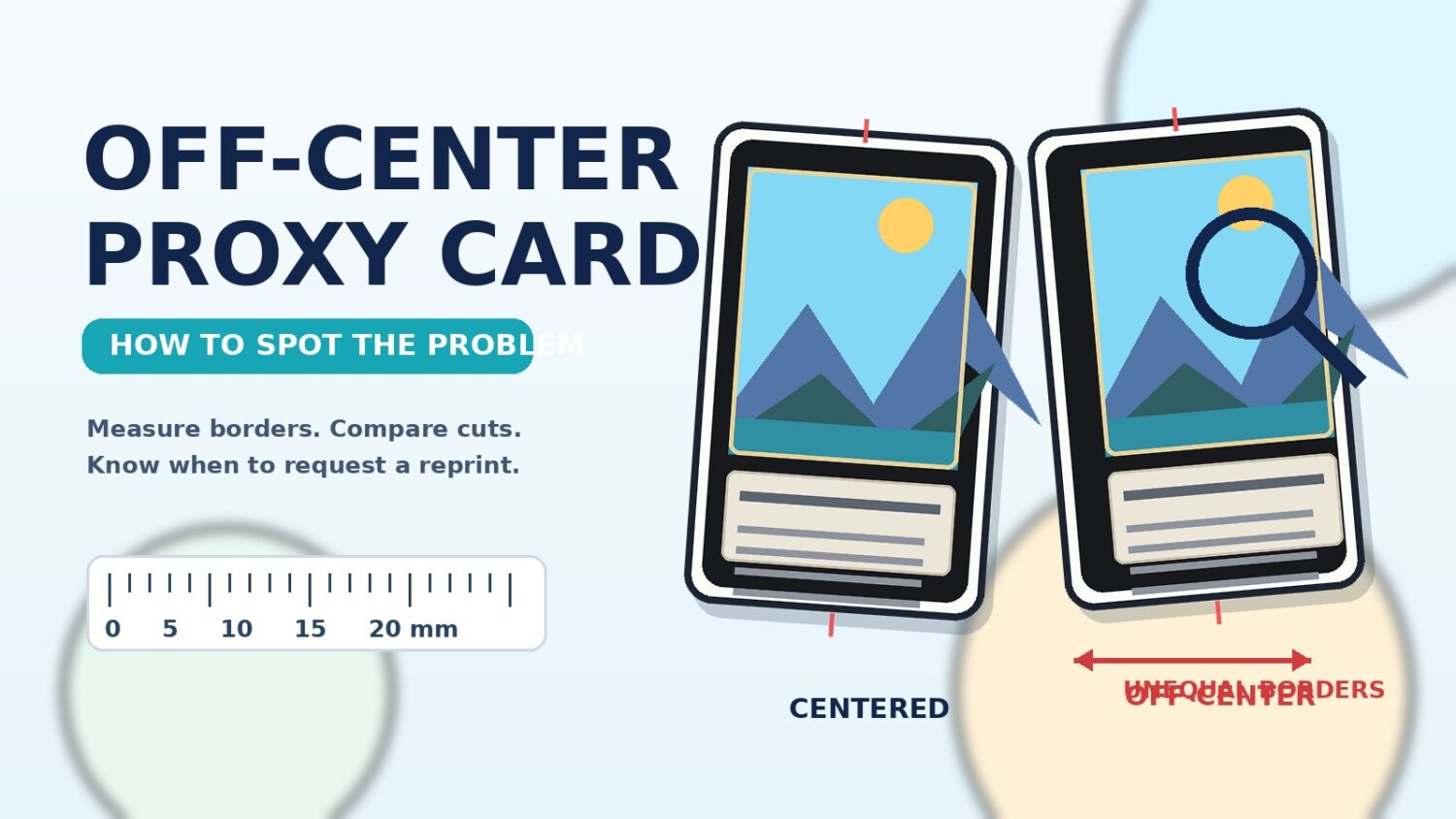
Imagine a card with a 2 mm border on all four sides. If the cut moves only 0.5 mm to the left, one side may now appear to have a 1.5 mm border while the other has a 2.5 mm border. The actual movement is small, but one border now looks substantially wider than the other.
This is why a borderless full-art card may look perfectly acceptable even when a traditional bordered version from the same sheet looks visibly off-center.
The Game Crafter demonstrates that even 0.5 mm of drift can be highly noticeable on a card with a 1.5 mm border. It also recommends full-bleed backgrounds because symmetrical borders emphasize ordinary production movement.
MTG card layouts are particularly unforgiving. The frame provides long, straight reference lines, and the human eye is annoyingly good at finding the one border that is wider than the others.
How to Measure an Off-Center Proxy Card
You do not need specialized inspection equipment. A metric ruler with half-millimeter markings is usually enough. Digital calipers or a flatbed scan can provide more precise measurements.
Measure the Four Borders
Place the card on a flat surface and measure:
- The left trim edge to the nearest consistent frame line
- The right trim edge to the matching frame line
- The top trim edge to a horizontal frame element
- The bottom trim edge to the matching frame element
Measure near the midpoint of each edge. Corners can be misleading because rounded corners remove part of the border.
For a symmetrical design, estimate the artwork shift using this formula:
Estimated horizontal shift = difference between the left and right borders divided by two
For example:
- Left border: 2 mm
- Right border: 4 mm
- Difference: 2 mm
- Estimated horizontal shift: 1 mm
Use the same method with the top and bottom measurements.
Check for Rotation
A card can be centered at its midpoint but still be rotated.
Measure the same border near both ends. If the left edge measures 2 mm near the top and 3 mm near the bottom, the artwork or cut may be slightly angled.
Check the Card Dimensions Separately
An off-center image and an incorrectly sized card are different defects.
Stack the card with several others and check whether:
- One edge extends beyond the rest of the stack
- The card is noticeably narrower or wider
- The corner radius differs
- The card fits sleeves differently
- The front is centered but the back is not
A card may have correct external dimensions while the artwork is shifted inside them.
What the Pattern Tells You
Inspect at least 10 to 20 cards before drawing a conclusion. The pattern across the order is often more useful than one especially ugly example.
Most Cards Shift in the Same Direction
This usually suggests sheet registration or cutting alignment. The production setup was consistently offset.
Cards Shift in Random Directions
This is more consistent with ordinary cutting drift or inconsistent sheet positioning.
Only One Card Design Is Off-Center
Check the source image. The artwork may have been improperly positioned before printing.
If every copy of the same design has the same unusual alignment while other cards look normal, the file is the leading suspect.
The Front Is Centered but the Back Is Not
This is a front-to-back registration issue. Inspect several cards to determine whether the back moves consistently or randomly.
A White or Unprinted Edge Is Visible
This usually means the design did not extend far enough into the bleed area, the cutting movement exceeded the available bleed, or both.
A visible white sliver is more serious than a slightly uneven border because properly prepared full-bleed artwork should continue beyond the intended cut.
Practical Off-Center Severity Guide
These are MTGProxyReviews.com inspection guidelines, not universal printing tolerances. Individual sellers may publish different standards.
Minor Variation
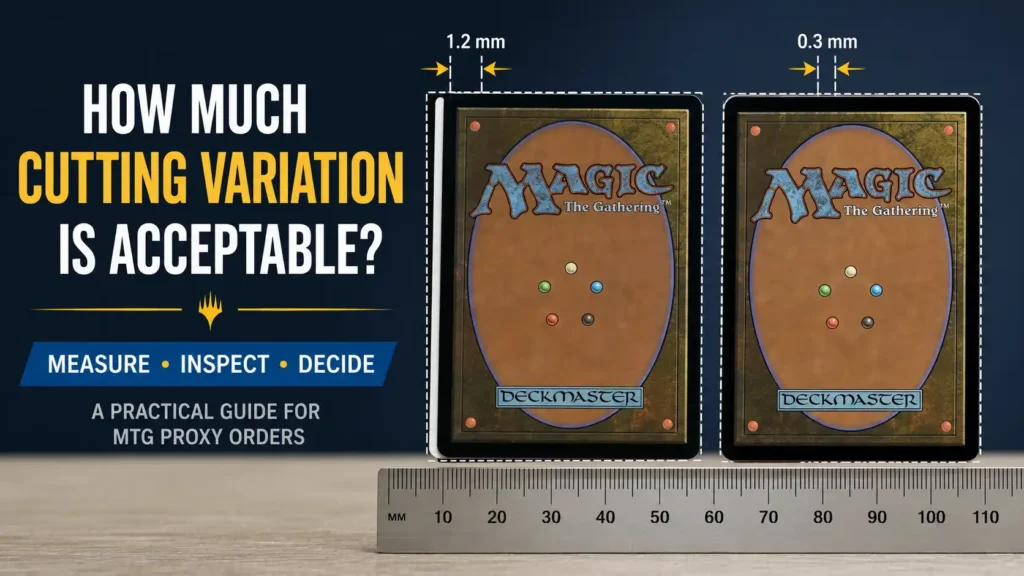
- Estimated movement of approximately 0.5 mm or less
- No important content affected
- No white edges
- Card dimensions remain consistent
- Difference is difficult to notice inside sleeves
This is usually ordinary production variation.
Noticeable Variation
- Estimated movement between approximately 0.5 and 1 mm
- Narrow borders appear visibly uneven
- Several cards show the same pattern
- Card remains readable and usable
Document the issue and inspect the rest of the order. Whether it justifies a reprint depends on the seller’s policy and the severity across the batch.
Likely Reprint Issue
- Movement repeatedly exceeds approximately 1 mm
- A card is shifted by roughly 1.5 mm or more
- Important text, symbols, or artwork enter the trim area
- A white or unprinted edge is visible
- Front-to-back alignment is severely inconsistent
- Cuts are rotated, jagged, or dimensionally incorrect
- A meaningful percentage of the order is affected
A single slightly uneven card may not justify reproducing an entire order. Twenty badly shifted cards in a 100-card Commander deck are a different matter.
Was It the File or the Printer?
Before requesting a reprint, compare the physical card with the submitted artwork or online proof.
The problem is more likely file-related when:
- The image was already uneven inside the template.
- Text or symbols were placed outside the safe area.
- The artwork stopped at the trim line instead of extending through the bleed.
- The uploaded image included a narrow decorative border.
- Every copy of one specific design has the same unusual alignment.
The problem is more likely production-related when:
- Many unrelated cards shift in the same direction.
- Duplicate copies of the same design are cut differently.
- The physical cut does not match the approved preview.
- A full-bleed image has a white edge.
- Cards are cut to inconsistent sizes.
- Corners or edges are visibly malformed.
Some published reprint policies exclude problems caused by customer-provided files while covering obvious cutting and finishing defects. Check the policy before assuming that every unattractive result qualifies automatically.
How to Document an Off-Center Order
Provide evidence that makes the issue easy to understand.
Include:
- The order number
- The number of affected cards
- One photograph showing several cards together
- Close-up photographs of representative defects
- A ruler or measurement reference in the image
- The measured left, right, top, and bottom margins
- A copy of the submitted artwork or approved proof
- A note explaining whether duplicate cards vary
- Photographs of any white edges, angled cuts, or damaged corners
Do not send only a highly magnified photograph of one border. Show the full card first, then the close-up.
A flatbed scan at 300 or 600 DPI can be useful for measuring centering, but scanners are less dependable for judging color and finish.
How to Reduce Off-Center Problems on Future Orders
You cannot eliminate all cutting variation, but you can make it less destructive.
- Extend backgrounds fully through the required bleed.
- Keep text, mana symbols, and other important content inside the safe area.
- Avoid extremely narrow, symmetrical borders.
- Use the printer’s current template instead of recreating it from memory.
- Check every custom upload at full size before ordering.
- Order a small sample before committing to a large custom deck.
- Ask the seller about its cutting tolerance and reprint policy.
- Inspect the online preview for automatic cropping or scaling.
A good design does not prevent the equipment from drifting. It prevents a small amount of drift from ruining the card.
Final Assessment
MTG proxy cards are off-center when the printed image and final cut do not align exactly. Some movement is normal, and narrow card borders can make a tiny difference look surprisingly severe.
Measure the card before deciding what happened. A shift of 0.5 mm may be cosmetic. Repeated movement beyond about 1 mm, visible white edges, damaged safe-area content, or inconsistent card dimensions provide a much stronger basis for a reprint request.
And always inspect more than one card. One strange cut is an incident. A deck leaning collectively to the left is a production pattern.
FAQs
Is a Slightly Off-Center MTG Proxy Card Defective?
Not necessarily. Minor cutting variation is expected in commercial printing, especially when the card has a narrow border that exaggerates small differences.
How Much Off-Center Movement Is Acceptable?
There is no universal standard for every proxy printer. As a practical inspection guideline, movement of 0.5 mm or less is usually minor, while repeated movement exceeding approximately 1 mm deserves closer review.
Why Are Some Cards Off-Center but Others Are Fine?
Cards may occupy different positions on a production sheet, and individual sheets can move during cutting. A single design may also have been improperly centered in its source file.
Can Sleeves Hide an Off-Center Cut?
Sleeves can make minor centering differences less distracting, but they will not correct white edges, severe miscuts, incorrect dimensions, or content cut near the edge.
Should I Request a Full Reprint for One Off-Center Card?
Usually, request replacement of the affected card rather than the entire order. A larger reprint becomes more reasonable when the issue affects many cards or indicates a consistent production problem.