TLDR
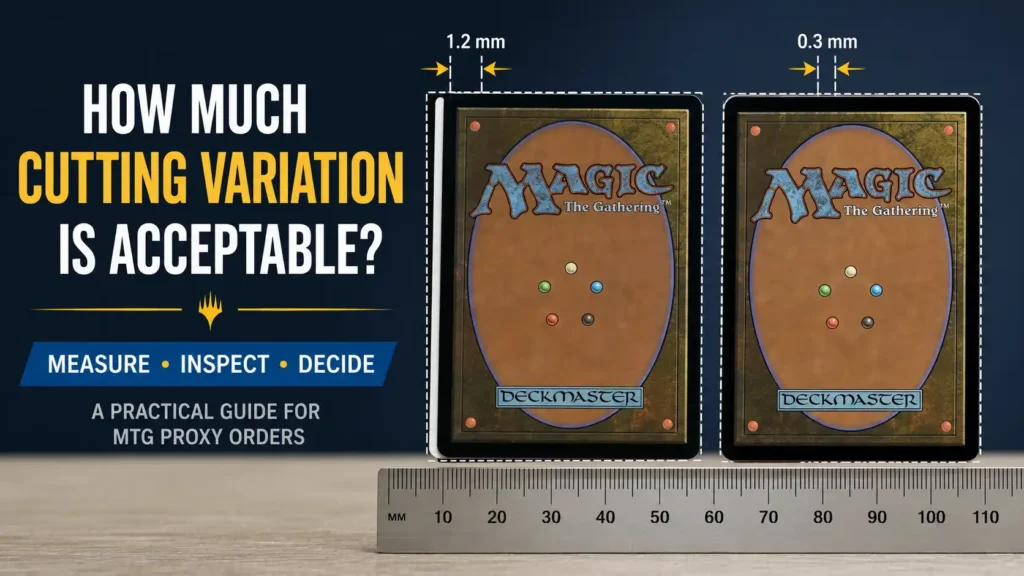
- Up to about 0.5 mm of image-to-cut variation is generally acceptable on an MTG proxy, provided nothing important is clipped and the card remains the correct size.
- Variation between 0.5 and 1.0 mm is noticeable and should be evaluated across the order rather than judged from one card.
- Repeated variation greater than 1.0 mm, or any obvious shift approaching 1.5 mm, is a reasonable basis for requesting a reprint from a quality-focused service.
- White edge slivers, clipped rules text, inconsistent card dimensions, skewed frames, jagged edges, and corners that catch sleeves are more serious than minor centering differences.
- Measure cards against the median size of the order, not just one official card. Custom-card manufacturers do not all use precisely the same finished dimensions.
- Bleed and safe zones protect a design from production movement. They do not automatically make every amount of cutting variation acceptable.
How much cutting variation is acceptable depends on what moved, how far it moved, and whether the defect affects normal use. A proxy card that is shifted by half a millimeter may look slightly off-center but still shuffle, sleeve, and play normally. A card that is one millimeter too wide can create a marked-card problem even when the artwork looks perfect.
The frustrating part is that most printers describe acceptable cutting with phrases such as “clean cuts” or “no obvious miscuts.” Those are useful promises, but they do not give the customer much to measure.
This guide provides practical inspection thresholds for evaluating an MTG proxy order. They are not universal industry standards. They are buyer-facing quality guidelines intended to distinguish harmless production movement from defects worth documenting and reporting.
The Direct Answer
For a quality-focused MTG proxy order, this is a practical starting point:
| Measured Variation | Practical Interpretation |
|---|---|
| 0 to 0.5 mm | Normally acceptable |
| More than 0.5 to 1.0 mm | Noticeable and worth monitoring |
| More than 1.0 to 1.5 mm | Significant, especially when repeated |
| More than 1.5 mm | Usually an obvious miscut |
| Any clipped text, white edge, or sleeve-fit problem | Reprint candidate regardless of measurement |
These thresholds primarily apply to image-to-cut alignment, sometimes called cutting drift or registration drift.
Finished card dimensions require a separate test. A perfectly centered card can still be too wide, too narrow, too tall, or too short.
What Cutting Variation Actually Means
Several different defects are casually described as “bad cutting.” They should be inspected separately because they have different causes and consequences.
Image-to-Cut Drift
Image-to-cut drift occurs when the printed image is not centered inside the finished cut.
Common signs include:
- One border is wider than the opposite border
- A title bar sits closer to one edge
- A full-art image appears shifted
- One side of a frame is partially trimmed
- A white or unprinted sliver appears along an edge
This is the type of variation most buyers notice first.
Even 0.5 mm can look significant on a card with a narrow, uniform border. The same movement may be nearly invisible on a full-bleed card with artwork extending beyond every edge.
Finished-Size Variation
Finished-size variation means that the physical card is not the intended width or height.
This can result in:
- Cards protruding from a stacked deck
- Cards fitting more tightly in sleeves
- Loose movement inside sleeves
- Corners sitting at different heights
- Specific cards being identifiable from the side of the deck
Size variation matters more than cosmetic centering because it can affect handling and make individual cards distinguishable.
Skew or Rotation
A skewed card has been cut at a slight angle. The artwork may look centered near the top but drift toward one side near the bottom.
Skew is often easier to identify by comparing the same border at two points:
- Measure the left border near the top
- Measure it again near the bottom
- Compare the two readings
A difference under 0.5 mm is usually minor. A difference approaching or exceeding 1 mm is clearly visible on most framed card designs.
Corner and Edge Variation
Cards can have the correct dimensions and still be poorly finished.
Inspect for:
- Jagged cut edges
- Chipped coating
- Flat spots on corners
- Mismatched corner radii
- Partially rounded corners
- Hanging paper fibers
- Corners that catch when inserted into sleeves
A slightly different corner shape is usually cosmetic. A rough or protruding corner that catches sleeves is a functional defect.
Recommended MTG Proxy Cutting Thresholds
The following thresholds are MTGProxyReviews.com inspection recommendations, not manufacturer specifications.
| Issue | Acceptable | Borderline | Reprint Candidate |
|---|---|---|---|
| Image-to-cut offset | Up to 0.5 mm | More than 0.5 to 1.0 mm | Repeated movement over 1.0 mm or any obvious shift over 1.5 mm |
| Width or height spread within order | Up to 0.3 mm | More than 0.3 to 0.5 mm | More than 0.5 mm when handling is affected, or approximately 1 mm in any case |
| Skew from top to bottom | Up to 0.5 mm | More than 0.5 to 1.0 mm | More than 1.0 mm |
| White edge sliver | None | Extremely small and isolated | Visible during ordinary handling |
| Clipped frame detail | Minor bleed-only artwork | Frame touches edge | Text, symbols, or functional information is clipped |
| Corner variation | Small cosmetic difference | Noticeably uneven | Jagged, chipped, incomplete, or sleeve-catching corners |
| Order consistency | One isolated borderline card | Several similar cards | A repeated defect across a meaningful portion of the order |
A 0.8 mm shift on one full-art token may not justify replacing a 500-card order. The same shift across forty Commander cards with narrow borders is a pattern, not an isolated imperfection.
Bleed Is Not an Acceptable-Quality Standard
Commercial print files include bleed because cutting equipment does not land in precisely the same position every time.
MakePlayingCards, for example, instructs customers to provide approximately 1/8 inch of bleed and keep important information within a separate safe area. The Game Crafter likewise explains that even 0.5 mm of drift becomes highly visible on a narrow border and recommends designing around potential movement.
These requirements help prevent white edges and clipped information. They should not be interpreted as permission for a printer to shift every card by the full bleed amount.
A 3 mm bleed means the background extends far enough to tolerate movement. It does not mean a 3 mm off-center card should be considered excellent work. A seat belt allows for accidents. It is not a suggested driving technique.
How to Measure Cutting Variation
You do not need laboratory equipment. A careful inspection requires:
- A digital caliper capable of reading tenths of a millimeter
- A ruler with millimeter markings
- A flat, well-lit surface
- Several opaque card sleeves
- A known-good card for handling comparisons
- A phone camera
- A spreadsheet or note for recording results
Digital calipers are the most useful tool because small differences are difficult to judge accurately with a ruler.
Step 1: Find the Order’s Median Size
Do not begin by assuming every service targets exactly 63 × 88 mm.
Manufacturers offer several similar card formats, including 63 × 88 mm and traditional 2.5 × 3.5 inch poker cards. A proxy service may also use its own cutting die or specification.
Measure at least ten cards from different parts of the order. Record the width and height of each, then identify the middle value.
Use that median as the comparison point for the rest of the order.
This helps distinguish a consistently produced deck from one containing random oversized and undersized cards.
Step 2: Measure at Several Points
Measure each suspicious card in at least four places:
- Width near the top
- Width near the bottom
- Height near the left
- Height near the right
The top and bottom widths should be nearly identical. The left and right heights should also agree.
A difference suggests skew, an uneven cut, or a damaged edge.
Do not press the caliper tightly enough to compress the card. Close it gently until both jaws contact the edges.
Step 3: Measure Centering
Choose a straight printed feature that should be equally spaced from the physical edges. This might be:
- The outer frame
- A title box
- A text-box boundary
- A custom border
- A repeated background element
Measure the distance from the printed feature to the left and right edges.
To estimate the actual center shift:
Center shift = difference between opposite margins ÷ 2
For example:
- Left margin: 3.0 mm
- Right margin: 2.0 mm
- Margin difference: 1.0 mm
- Estimated center shift: 0.5 mm
Do not judge cutting from a single frame element when the original file may already be off-center. Compare multiple cards using the same artwork when possible.
Step 4: Perform the Stack Test
Align twenty to thirty cards on a flat surface and press two edges against a straight object.
Look and feel for:
- Cards protruding from the stack
- Uneven top edges
- A single card that is visibly wider
- Corners extending past the others
- A stepped or fan-shaped stack
Repeat the test after rotating the cards 180 degrees.
The stack test often reveals size problems faster than measuring every card individually.
Step 5: Perform the Sleeve Test
Place several normal cards and the suspicious card in identical opaque sleeves.
Check whether:
- One sleeve is stretched more tightly
- One card slides upward or downward more easily
- The card protrudes above the others
- Its corners sit differently
- It can be identified by touch
A variation becomes more serious when it remains detectable through an opaque sleeve.
Use a 30-Card Inspection Sample
For an order larger than approximately 100 cards, begin with a structured sample rather than measuring every card immediately.
Select 30 cards from throughout the order:
- Ten from the beginning of the stack
- Ten from the middle
- Ten from the end
Then use this escalation rule:
| Result From 30-Card Sample | Recommended Action |
|---|---|
| No significant defects | Complete a quick visual inspection of the remainder |
| One borderline card | Record it and continue visually |
| Two or three borderline cards | Measure another 30 cards |
| One obvious miscut | Inspect nearby cards and document the defect |
| Four or more affected cards | Inspect the complete order and contact the service |
This is not a statistical certification system. It is a practical method for discovering whether the problem is isolated or recurring.
File Problems Versus Cutting Problems
Before requesting a reprint, determine whether the physical cut caused the issue.
A printer-caused problem is likely when:
- Multiple copies of the same file are centered differently
- The back is aligned differently from the front
- Physical card dimensions vary within the order
- One edge has an unprinted white sliver despite sufficient bleed
- The cut enters information that was clearly inside the provider’s safe zone
- Corners or edges are mechanically inconsistent
A customer-file problem is more likely when:
- Every copy is misaligned in exactly the same way
- The supplied design did not include bleed
- Text was placed outside the safety margin
- The uploaded image already contained an uneven border
- The wrong template or finished size was used
- The design preview showed the same cropping before purchase
This distinction matters because custom printers commonly exclude customer-provided artwork errors from complimentary reprints.
When Should You Request a Reprint?
Request a reprint when the defect is obvious, repeated, functional, or contrary to the company’s published quality promise.
Strong reprint cases include:
- Important text, mana symbols, names, or power and toughness are clipped
- White strips appear along printed edges
- Cards are visibly different sizes
- Cards can be identified through sleeves
- Repeated centering variation exceeds approximately 1 mm
- An individual card has an obvious shift approaching or exceeding 1.5 mm
- The frame is visibly rotated
- Corners are jagged, chipped, or incomplete
- A substantial portion of the order shares the same defect
PrintMTG’s current quality guarantee explicitly includes clean cuts, uniform corners, and freedom from obvious miscuts. It also states that cutting and cornering mistakes caused by the company qualify for a reprint at its cost.
Not every service is that specific. Some policies limit remedies to what the seller considers a “severe defect,” which makes detailed documentation particularly important.
How to Document a Cutting Problem
A strong reprint request should include:
- The order number
- The number of affected cards
- A short description of the defect
- One photo showing the complete affected group
- Close-up photos of representative cards
- A ruler or caliper visible in at least one image
- A photo of affected cards aligned in a stack
- Front and back photos when alignment differs between sides
- A comparison with an acceptable card from the same order
- A clear requested resolution
Avoid sending twenty extreme close-ups without showing how widespread the issue is. The service needs to see both the defect and its frequency.
A useful message might state:
“Fourteen of the 100 cards are visibly shifted to the right. Measured image-to-cut movement ranges from approximately 1.1 to 1.6 mm, and three cards have visible white edges. The attached photos show the affected cards together, representative measurements, and a comparison with properly cut cards from the same order.”
That is easier to evaluate than “the cuts look weird.”
Common Inspection Mistakes
Using One Official Card as the Only Standard
Official cards also vary slightly, and proxy services do not all use exactly the same nominal format. Compare the order internally before comparing it with a single reference card.
Confusing an Off-Center File With a Miscut
A scanned or custom image can be poorly centered before printing. Check whether repeated copies have the same alignment.
Measuring Only the Artwork
The physical card size matters independently of the print position. Measure both.
Ignoring the Back
Front-to-back registration can reveal cutting or printing movement that is less obvious from the front alone.
Rejecting Every Visible Difference
Some drift is unavoidable. A tiny centering difference that requires calipers to discover is not the same as a defect visible during normal play.
Accepting a Marked Card Because It Looks Fine
A card that protrudes from a sleeved deck is a functional problem even when its artwork is perfectly centered.
Final Recommendation
The practical answer to how much cutting variation is acceptable is approximately 0.5 mm for ordinary image-to-cut drift, with closer scrutiny between 0.5 and 1.0 mm.
Movement beyond 1.0 mm should not automatically be ignored as normal production variation. Consider how often it appears, whether the design makes it more noticeable, and whether it affects card handling. Repeated shifts over 1.0 mm, obvious movement over 1.5 mm, clipped information, visible white edges, rough corners, and inconsistent physical dimensions are reasonable grounds for contacting the printer.
The best inspection method combines measurements with actual play conditions. Measure the card, stack it, sleeve it, and determine whether it behaves like the rest of the order.
Calipers provide a number. The sleeve test tells you whether that number matters.
Frequently Asked Questions
Is 1 mm of cutting variation acceptable on an MTG proxy?
One millimeter is borderline to significant. It may be usable on a full-bleed design, but repeated 1 mm shifts should be documented and discussed with a quality-focused printer.
How can I tell whether a card is miscut?
Compare opposite borders, measure the card at several points, inspect it in a stack, and test it in an opaque sleeve. A miscut may affect centering, finished dimensions, skew, corners, or several of these at once.
Does bleed mean the printer can cut anywhere inside the bleed area?
No. Bleed protects the design from small production movement. It is a file-preparation allowance, not a blanket finished-quality tolerance.
Should every proxy card measure exactly the same?
Perfectly identical dimensions are unrealistic, but cards within the same order should be extremely consistent. Variations should not be obvious in a stack or detectable through sleeves.
Is an off-center card always eligible for a reprint?
No. Eligibility depends on the severity, the provider’s policy, the supplied file, and whether the problem was caused during production. A mildly off-center full-bleed card may still fall within normal variation.
What photos should I send with a reprint request?
Send an overview of all affected cards, close-ups of representative defects, measurements with a ruler or caliper, and a comparison with correctly cut cards from the same order.
References
- Quality Guarantee & Reprints, PrintMTG. Current guarantees covering clean cuts, uniform corners, obvious miscuts, documentation, and printer-caused reprints. Accessed July 23, 2026.
- Drift, The Game Crafter. Explanation of image-to-cut drift, border sensitivity, and bleed allowances. Accessed July 23, 2026.
- Image Upload Tips, MakePlayingCards. Guidance covering bleed, safe areas, resolution, and finished poker-card dimensions. Accessed July 23, 2026.
- Templates, The Game Crafter. Template proportions, cut lines, bleed areas, and safe zones. Accessed July 23, 2026.