TLDR
A proxy printing service should reprint an order when a production, finishing, fulfillment, or shipping error materially affects the cards.
A reprint is normally justified when cards are unreadable, incorrectly cut, missing, duplicated, badly damaged, improperly coated, incorrectly paired, or inconsistent enough to become identifiable in sleeves.
Minor color differences, tiny cosmetic marks, and normal cutting variation do not always justify replacing an entire order. Isolated defects should usually receive an affected-card replacement. A full reprint makes more sense when the problem is systematic or affects a meaningful percentage of the order.
Inspect cards immediately. Some printers require customers to report defects within as little as three days.
The Direct Answer
When should a proxy printing service reprint an order? The clearest answer is when the delivered cards do not reasonably match the approved order or cannot perform their intended function because of an error caused by the printer.
That includes more than spectacular printing failures. A Commander deck with one missing card is incomplete. A double-sided card with the wrong back is incorrect. Cards with inconsistent dimensions may become identifiable through opaque sleeves. A coating defect can make an otherwise sharp card unpleasant to shuffle.
At the same time, commercial printing involves some natural variation. Two cards may not have mathematically identical borders, and a printed image will not always match a backlit computer monitor. The question is not whether the cards are microscopically perfect. The question is whether the defect is noticeable, repeated, and material.
Cardstock cannot file a complaint, so the customer has to do the inspection.
What Counts as a Material Defect?
A material defect affects at least one of four things:
- Readability
- Appearance
- Handling
- Order accuracy
A cosmetic flaw can still be material when it appears across enough cards. One tiny spot on the reverse of one token is different from the same spot appearing on every card in a 100-card deck.
The following framework provides a practical starting point.
| Issue | Usually Acceptable | Reprint Threshold |
|---|---|---|
| Print clarity | Slight softness caused by the supplied artwork | Unreadable text, doubled images, heavy banding, missing print, or widespread blur |
| Color | Moderate differences from a monitor or official printing | Severe color cast, missing color channel, crushed dark detail, or inconsistent color within the same order |
| Centering | Small border differences that do not affect the frame | White edges, trimmed text, exposed bleed, or visibly severe frame displacement |
| Card size | Tiny variation that does not affect stacking or sleeves | Cards that protrude, bind in sleeves, or can be identified by size |
| Corners | Slight variation visible only during close inspection | Sharp points, jagged corners, major corner deformation, or inconsistent radius across the order |
| Finish | Subtle gloss variation under angled light | Sticky cards, missing coating, widespread scratches, peeling, or flaking |
| Construction | Normal flexibility and slight temporary curl | Delamination, persistent warping, unusual thickness, or splitting layers |
| Order accuracy | No meaningful variation is acceptable | Missing cards, wrong cards, incorrect quantities, duplicate substitutions, or mismatched fronts and backs |
| Shipping condition | Minor wear to outer packaging | Creases, water damage, crushed card corners, bent cards, or significant surface damage |
These are editorial benchmarks, not universal contractual standards. The seller’s published guarantee still matters. Unfortunately, “normal tolerance” is often left undefined, which is not especially useful when one side of a card has nearly lost its border.
When Cutting Problems Justify a Reprint
Cutting variation is one of the most common areas of disagreement.
Printers require bleed and safe margins because the cut will not land in precisely the same position on every card. Some movement should therefore be expected. That does not mean every cut is acceptable.
A reprint is usually justified when:
- An unprinted white edge is visible
- Rules text, names, mana costs, or other important content is trimmed
- One border is nearly gone while the opposite border is unusually wide
- Card dimensions vary enough to disrupt stacking
- Cards catch or fit differently in the same brand of sleeve
- Corners are jagged, pointed, chipped, or visibly inconsistent
- The same cutting error appears repeatedly throughout the order
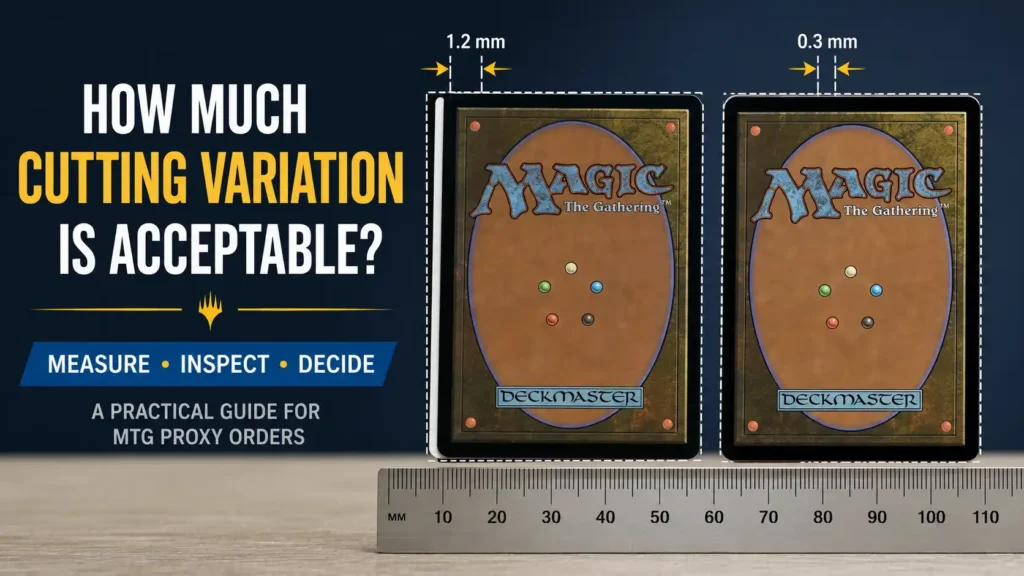
For a quick centering test, measure the visible border on opposing sides of several cards with a millimeter ruler or digital caliper. In our view, an opposing-border difference of roughly 1.5 millimeters or more becomes reprint-worthy when it appears on multiple cards and is clearly visible during ordinary handling.
The measurement is less important than the result. A technically measurable shift that nobody notices is not the same as a deck containing several cards that look as though they were cut during a minor earthquake.
Print and Color Problems
Printed color should be judged within the order before it is judged against a monitor.
Screens emit light. Printed cards reflect it. The finished cards may therefore appear slightly darker, less saturated, or warmer than the uploaded image. An official Magic printing is not always a reliable color target either because official cards can vary between sets, facilities, and print runs.
A reprint becomes appropriate when the variation appears to come from the production process rather than the source artwork. Warning signs include:
- Heavy horizontal or vertical banding
- Double images or registration shadows
- Toner voids or unprinted patches
- A strong green, red, blue, or yellow cast across the order
- Dark artwork losing so much detail that important elements disappear
- Black text printing gray or fuzzy
- Identical artwork printing noticeably differently within one order
- Surface contamination trapped beneath the coating
- Repeated scratches or roller marks
A slightly dark card may be disappointing without being defective. A full deck that looks as though every card was printed through brown sunglasses is another matter.
Finish and Card Construction Defects
The surface finish affects durability, shuffling, glare, and how easily cards slide against one another.
A new proxy order may feel slightly different from official cards, especially when the printer uses a different coating or cardstock. Different does not automatically mean defective.
A reprint should be considered when cards:
- Stick together during ordinary handling
- Have visibly missing or uneven coating
- Shed, flake, or peel at the surface
- Arrive with widespread scratches
- Show bubbling or trapped debris
- Separate into visible layers
- Remain severely curled after acclimating indoors
- Feel substantially thicker or thinner within the same order
- Can be identified in a sleeved deck by stiffness or thickness
For thickness testing, measure a stack of ten cards rather than a single card. Small individual measurements can be difficult to take accurately with inexpensive calipers. Measuring ten cards amplifies the difference, and the result can then be divided by ten.
The more important test is practical: stack the proxies with several official cards, place them in identical opaque sleeves, and check whether any card protrudes, bends differently, or can be located by touch.
Wrong, Missing, and Mismatched Cards
Order-accuracy errors are the easiest category to judge.
A printer should replace any card that is:
- Missing
- Incorrect
- Printed twice in place of another card
- Supplied in the wrong quantity
- Paired with the wrong reverse side
- Printed with artwork different from the approved selection
- Sent in the wrong language or version
A full reprint is not usually necessary when only one or two cards are missing. The service should replace those cards and cover the replacement shipping.
A broader reprint may be appropriate when the error is systematic. Examples include an entire double-sided batch being paired incorrectly, every card receiving the wrong back, or a decklist-import failure affecting dozens of selections.
When the Customer’s File Is the Problem
Not every disappointing result is the printer’s fault.
A service generally should not be expected to provide a free reprint because the customer:
- Uploaded a low-resolution image
- Submitted the wrong artwork
- Misspelled custom rules text
- Selected an incorrect card version
- Submitted an incomplete decklist
- Placed text outside the stated safe area
- Approved an inaccurate proof
- Changed their mind about a design after production
The exception is when the website, proofing system, or production staff materially changed the supplied file without warning. If the preview showed the full frame but the final card was automatically cropped, the service may share responsibility.
Good ordering tools should warn customers about resolution, bleed, image placement, and missing files. But even the best uploader cannot determine whether “Gary, Destroyer of Leftovers” was intentionally submitted as the commander.
Partial Replacement or Full Reprint?
The remedy should match the scope of the problem.
Replace the Affected Cards When:
- Only a few cards are missing or incorrect
- Damage is isolated to one small group
- One sheet or packet contains cutting problems
- Most of the order is otherwise consistent and usable
- A few cards have scratches, coating defects, or crushed corners
Reprint the Full Order When:
- The entire order has severe print or color problems
- A large percentage of cards are miscut
- The wrong finish or cardstock was used
- Every card has the wrong back
- The cards are systematically oversized or undersized
- The order is inconsistent enough to create marked cards
- Widespread shipping damage makes the order unusable
- Sampling reveals the same defect throughout multiple packets
As a practical benchmark, a recurring production defect affecting more than approximately 10 percent of a large order should trigger a discussion about reprinting the full affected batch. That is not a universal industry rule. It is a reasonable decision threshold because inspecting and replacing cards individually becomes less reliable as the defect spreads.
A single serious defect can also be enough. One missing card in a 100-card Commander list does not require 100 new cards, but it does require a replacement.
How to Inspect a Proxy Order
Inspect the cards before shuffling, sleeving, or playing with them.
1. Photograph the Package
Take pictures of the unopened mailer or box, especially if it appears crushed, wet, torn, or resealed.
2. Count the Cards
Compare the received quantity with the order confirmation. Separate tokens, double-sided cards, custom designs, and duplicate copies.
3. Check Every Card Quickly
Give every card a basic front-and-back inspection. Look for incorrect art, missing cards, scratches, white edges, severe color shifts, and mismatched backs.
4. Measure a Sample
For a 100-card order, closely measure approximately 10 to 20 cards, including cards from different parts of the package. Measure any card that looks unusual.
5. Perform a Stack Test
Stack 20 to 30 cards and tap each edge against a flat surface. Oversized, undersized, or badly cornered cards will often become visible immediately.
6. Inspect Under Neutral Light
Use indirect daylight or a neutral white lamp. Strong yellow household lighting can make color problems look worse, while direct glare can hide surface defects.
7. Test Standard Sleeves
Place several cards into the same brand and batch of opaque sleeves. Check fit, height, thickness, stiffness, and whether any card is distinguishable.
8. Keep the Packaging
Do not discard the mailer, label, card bands, wrappers, or protective cases until the order has passed inspection.
How to Submit a Strong Reprint Claim
Contact the service as soon as possible. Published claim windows vary substantially.
Provide:
- The order number
- Delivery date
- A short description of the problem
- The names and quantities of affected cards
- A photograph showing the complete order
- Close-up photographs of each defect type
- A ruler or caliper in the frame when size or cutting is disputed
- Photographs of the package and shipping label for transit damage
- A clear requested resolution
For example:
“Seven cards have visible white edges, and four are approximately one millimeter narrower than the rest of the deck. I have attached a group photo, individual close-ups, and measurements. Please reprint the eleven affected cards.”
That is easier to evaluate than a dim photograph accompanied by “cards bad.”
What Current Reprint Policies Show
Current policies illustrate why customers should inspect orders immediately.
PrintMTG publicly covers errors involving printing, finishing, cutting, cornering, packing, incorrect items, and certain shipping mistakes. Its policy asks for an order number, a description, and supporting photographs.
ProxyMTG requires quality, damage, and incorrect-item claims within 14 days of delivery. Depending on the scope, it may provide a replacement, partial refund, or full refund.
ProxyKing asks customers to report covered issues within seven days. Its policy specifically lists major color problems, severe banding, misaligned cuts beyond normal tolerance, missing cards, incorrect cards, and significant transit damage.
MakePlayingCards has a considerably shorter window. Its published policy asks customers to report quality problems within three days of arrival and may require unused items to be returned for inspection.
The lesson is simple: do not leave a proxy order unopened on a shelf for two weeks and assume every provider will still treat the claim the same way.
What a Good Reprint Policy Should Include
A trustworthy proxy printing service should publish:
- A clear claim deadline
- Specific examples of covered defects
- Specific examples of customer-file problems
- Photo and documentation requirements
- An explanation of partial and full replacements
- Responsibility for replacement shipping
- Expected reprint timing
- A process for missing or incorrect cards
- Coverage for shipping damage
- A clear contact method
“Satisfaction guaranteed” sounds pleasant, but measurable standards are considerably more useful once 100 cards arrive with the same pale stripe through the artwork.
Responsible Use Still Matters
A replacement should correct the order, not make a proxy easier to misrepresent as an authentic Magic card.
Use clearly distinguishable backs, custom markings, or other features that prevent confusion. Tell your playgroup that proxies are present, follow store and event policies, and do not sell or trade proxy cards as genuine products.
A card can be extremely well printed and still be a proxy. Print quality does not change its origin.
Final Verdict
A proxy printing service should reprint an order when its own production, finishing, fulfillment, or shipping error creates a material problem.
The strongest claims involve unreadable printing, severe banding, incorrect colors, major cutting errors, damaged construction, missing cards, wrong cards, mismatched sides, or transit damage. Minor variations that do not affect appearance or use may not justify replacement.
The fairest remedy is proportional. Replace isolated defective cards. Reprint an affected batch when the problem is repeated. Reprint the full order when the entire product is inconsistent, unusable, or distinguishable during play.
The final test is practical: would a reasonable customer need to remove, replace, resleeve, or repeatedly explain the card because of the defect? If the answer is yes, and the printer caused the problem, the service should make it right.
FAQs
Does One Miscut Card Justify a Reprint?
Yes, the affected card should normally be replaced when the miscut is obvious or affects the frame, text, dimensions, or sleeve fit. It does not usually justify reprinting every card in the order.
How Much Centering Variation Is Acceptable?
Small border differences are normal. A reprint becomes reasonable when the displacement is immediately visible, exposes an unprinted edge, trims important content, or repeatedly creates opposing-border differences of roughly 1.5 millimeters or more.
Should Slightly Dark Proxy Cards Be Reprinted?
Not necessarily. Printed cards commonly appear different from backlit screens. Reprinting is more justified when the cards are severely dark, lose important detail, or show inconsistent color within the same order.
What Should I Do Before Contacting Customer Service?
Count the cards, photograph the full order, take close-ups, preserve the packaging, and identify every affected card. Submit the claim before the service’s deadline.
Can a Printer Refuse a Reprint Because of My Artwork?
Yes. Low-resolution images, incorrect text, poor cropping, and mistaken card selections are normally the customer’s responsibility when the final product matches the submitted file or approved proof.
Should Shipping-Damaged Cards Be Replaced?
Yes, significant transit damage should normally qualify for replacement. Photograph the packaging, label, and damaged cards before discarding anything.