TLDR
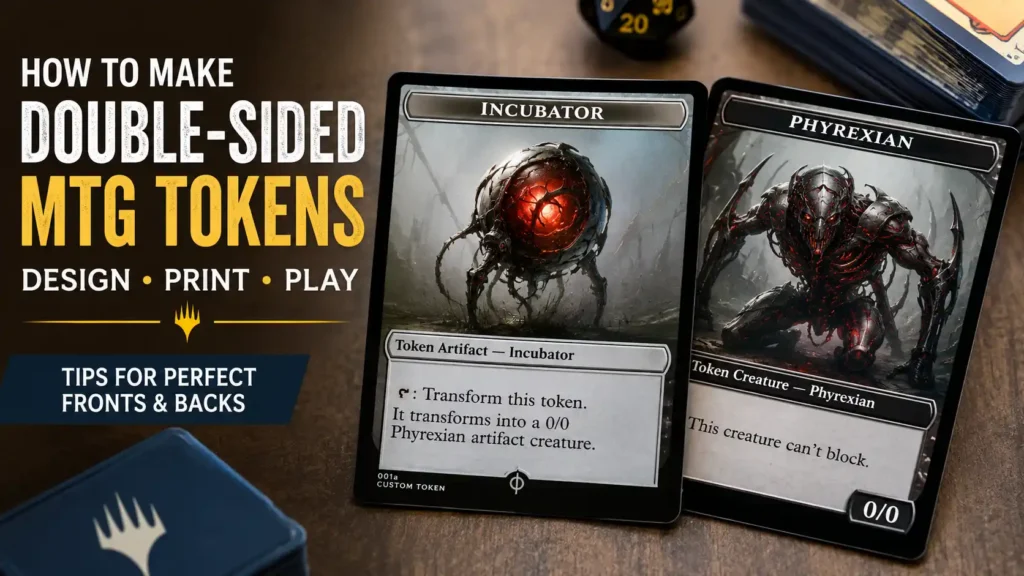
- Double-sided tokens work best when the two faces represent mutually exclusive states, such as an Incubator and its transformed Phyrexian.
- Do not pair two tokens that your deck frequently needs on the battlefield at the same time.
- Use a standard card size of approximately 63 × 88 mm, artwork at 300 PPI or higher, sufficient bleed, and generous safety margins.
- Name and number every front-and-back pair so the printer cannot accidentally match your Goblin with the reverse side of an unrelated Food token.
- PrintMTG is our practical recommendation for most players who want an MTG-specific token creator and straightforward ordering. MakePlayingCards offers greater control over individual card backs, materials, and larger custom sets.
- Use original or properly licensed artwork, avoid authentic-looking Magic card backs, and make every token easy to identify during play.
Learning how to make double-sided MTG tokens is not particularly difficult. Getting all the fronts matched with the correct backs, facing the same direction, cut cleanly, and readable from across the table takes a little more planning.
The basic design can be completed in minutes. The pairing spreadsheet is what prevents twenty beautifully printed mistakes.
What Is a Double-Sided MTG Token?
A double-sided MTG token has a playable token face printed on each side. The two sides might represent:
- A transforming token and its transformed state
- Two different tokens that are unlikely to be needed simultaneously
- A token and a game-state reminder
- Two artwork variations of the same token
- A normal token and a dry-erase or informational reverse
- A token creature and a copy reminder
Magic’s Comprehensive Rules define a token as a marker used to represent a permanent that is not represented by a card. The rules also specifically recognize double-faced tokens. Incubators, for example, have an artifact front and a Phyrexian creature back. A token copying a double-faced permanent can also have both corresponding faces and may be able to transform.
That distinction matters. A custom token is a game marker, not an unofficial replacement card hidden inside your deck. It does not need a realistic Magic card back. In fact, giving it one usually creates more problems than it solves.
Decide Which Tokens Belong Together
The most important decision happens before opening a card-design tool.
Ask one question about every proposed pairing:
Could I reasonably need both sides on the battlefield at the same time?
If the answer is yes, they probably should not share a physical card.
Good Double-Sided Pairings
- Incubator on the front, Phyrexian on the back
- A transforming copied creature and its reverse face
- Day on one side, Night on the other
- The Monarch on one side, The Initiative on the other
- A rare legendary token paired with another rarely created token
- A creature token paired with a reminder of the ability that created it
- Two visual versions of the same token
Poor Double-Sided Pairings
- Treasure and Clue in an artifact-token deck
- Zombie and Skeleton in a graveyard deck
- Soldier and Human in a deck that produces both
- Food and Blood in a deck built around sacrificing several artifact types
- Your two most frequently produced creature tokens
A double-sided card saves space only until you need both faces. At that point, it becomes a very small argument with a piece of cardstock.
Plan the Right Number of Tokens
There is no official number of token cards required for a deck. The correct quantity depends on how often each token is created and how many copies tend to exist simultaneously.
Use these ranges as planning guidance rather than fixed rules.
| Token Use | Suggested Quantity | Pairing Advice |
|---|---|---|
| Unique emblem or legendary token | 1 to 2 | Pair with another uncommon game piece |
| Occasional creature token | 2 to 4 | Pair with a token that rarely appears at the same time |
| Treasure, Clue, Food, or Blood | 3 to 6 | Use dice for larger quantities |
| Deck’s primary creature token | 6 to 10 | Avoid placing another important token on the reverse |
| Generic copy token | 2 to 4 | Use the reverse for notes or another copy layout |
| Transforming token | 2 to 6 | Put the correct transformed state on the reverse |
| Large swarm strategy | 6 to 12 | Combine physical tokens with dice to track quantity |
You do not necessarily need thirty identical Goblins. Six clear token cards and a few dice usually communicate the board state better than an advancing cardboard civilization.
Make a Front-and-Back Pairing List
Create a spreadsheet before preparing the final files. Include these columns:
| Pair Number | Front Face | Back Face | Quantity | Can Both Be Needed? | Status |
|---|---|---|---|---|---|
| 001 | Incubator | Phyrexian | 4 | No | Ready |
| 002 | Soldier | Treasure | 3 | Possibly | Reconsider |
| 003 | Copy Token | Copy Notes | 2 | No | Ready |
Give each finished file a matching number:
001-incubator-front.png001-phyrexian-back.png002-soldier-front.png002-treasure-back.png
Do not rely on alphabetical sorting or the order in which files happen to appear in a folder. “Surely the printer will understand” is not a production method.
Design Each Token Face for Readability
A token should communicate its important characteristics quickly. For most creature tokens, include:
- Token name
- Creature types
- Color
- Power and toughness
- Relevant abilities
- Easily recognized artwork
- A clear visual difference from the reverse side
A 1/1 white Spirit creature token with flying should not require the other players to inspect three lines of decorative flavor text before blocking it.
Make Power and Toughness Prominent
Power and toughness should be large enough to read from normal tabletop distance. Do not bury them inside artwork or place them directly against the cut edge.
For tokens with variable power and toughness, consider:
- An empty box for a dry-erase value
- “/” with a brief explanation
- A clearly marked area for dice
- Several versions for commonly reached values
Include the Full Relevant Ability
Evergreen keywords such as flying, vigilance, deathtouch, or haste should be printed clearly. Longer abilities may require a simplified layout, but the token still needs to represent the correct game characteristics.
Do not add abilities merely because they are commonly associated with that creature type. Not every Vampire has lifelink, despite their impressive commitment to the theme.
Make the Two Sides Easy to Distinguish
Use different artwork, background values, borders, or labels on the two faces. This is especially important for transformed tokens.
Do not rely on a tiny arrow as the only difference between sides.
Use the Correct File Size, Resolution, and Bleed
Always begin with the template supplied by the printer. Different services use different bleed and safety requirements, even when the finished cards are nearly the same size.
A practical starting point is:
| Specification | Recommended Setup |
|---|---|
| Finished size | Approximately 63 × 88 mm |
| Resolution | 300 PPI minimum |
| Orientation | Portrait unless intentionally designed otherwise |
| Color mode | Follow the printer’s RGB or CMYK instructions |
| Bleed | Use the provider’s template |
| Important text safety | Keep well inside the cut line |
| File format | High-quality PNG, JPG, TIFF, or PDF as accepted |
| Front and back canvas | Exactly the same dimensions |
For an MTG-specific printer, approximately 0.03 inch of bleed and at least 0.05 inch of internal safety are reasonable working targets when no stricter template is provided.
MakePlayingCards uses a more generous specification for its custom TCG cards. Its current instructions list 63 × 88 mm cards, a minimum resolution of 300 PPI, 1/8 inch of bleed, and an additional 1/8 inch internal safety margin. Each card can be customized individually on both its front and back.
Do not take a file made for one printer and automatically upload it to another. A design prepared for a small bleed allowance can fail badly when placed inside a larger template.
Avoid Thin Borders on Both Sides
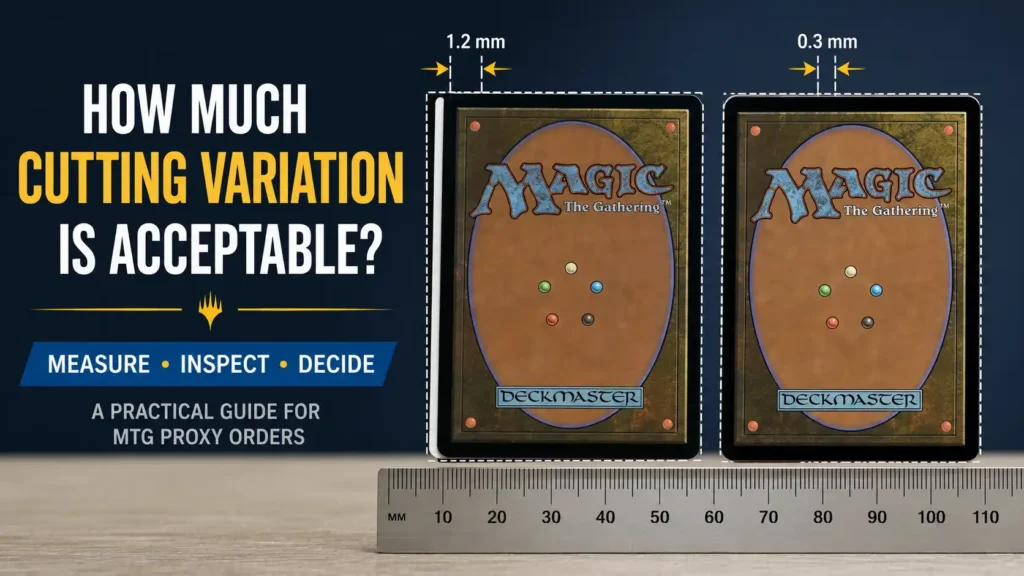
Front-to-back alignment is never perfectly mechanical. Small registration and cutting variations can make a centered design appear slightly different on each side.
To make minor variation less visible:
- Extend backgrounds fully through the bleed area
- Avoid thin rectangular borders near the edge
- Keep frames comfortably inside the cut line
- Use forgiving full-art or borderless backgrounds
- Keep matching design elements away from opposite edges
- Do not place critical text close to a corner
A one-millimeter shift is barely noticeable in full-bleed artwork. It becomes extremely noticeable when a narrow border gets thicker on one side and nearly disappears on the other.
Check the Back Orientation
Both files should have the same top edge unless the printer specifically instructs otherwise.
Before ordering, perform a paper test:
- Print the front on ordinary paper.
- Print or tape the proposed back behind it.
- Cut around the card.
- Hold the front upright.
- Flip it from left to right as you would during a game.
- Confirm that the reverse is also upright.
Repeat the test by flipping over the top edge. This helps identify whether the provider’s preview expects long-edge or short-edge rotation.
Professional card printers normally handle the physical sheet orientation. Your job is to supply consistently oriented files and verify the digital preview.
Compare Surface Finishes
The most decorative finish is not automatically the best token finish.
| Finish | Main Advantage | Main Weakness | Best Use |
|---|---|---|---|
| Smooth or matte | Readable with controlled glare | Colors may look slightly less saturated | General gameplay tokens |
| Standard coated finish | Balanced appearance and handling | Quality varies by printer | Matching ordinary card decks |
| Gloss | Strong color and contrast | Glare and fingerprints | Display tokens and gifts |
| Linen | Tactile surface and traditional card feel | Texture can soften tiny details | Original game components |
| Dry-erase laminate | Reusable and easy to update | Marker residue and different handling | Copy tokens and variable stats |
| Foil or holographic | Decorative and attention-grabbing | Glare, cost, and possible curl | Commanders, emblems, and special tokens |
For an ordinary Commander token set, a smooth or lightly coated finish is usually the safest choice. Foil looks impressive until overhead lighting turns the rules text into a small mirror.
Where to Print Double-Sided MTG Tokens
PrintMTG: Best Starting Point for Most Players
PrintMTG is our practical recommendation for players who want an MTG-specific creation process rather than a general playing-card manufacturing interface.
Its current card maker allows users to select a frame, upload and position artwork, edit card details, preview the design live, and add the finished card directly to an order. The tool is explicitly presented as suitable for custom tokens as well as custom cards.
The main advantages are:
- MTG-oriented layouts
- Live design preview
- Direct printing from the card maker
- Easier creation of matching token sets
- Less technical setup than a general manufacturer
Before payment, confirm that every reverse face is assigned to the intended front in the cart or proof. The design tool solves the artwork problem, but front-to-back pairing still deserves human attention.
MakePlayingCards: Best for Advanced Control
MakePlayingCards is the stronger specialist option for artists and experienced designers who want:
- A different front and back on every card
- Multiple cardstock choices
- Smooth, linen, plastic, and black-core options
- Specialty printing and packaging
- Large original token sets
- Precise control over finished files
Its custom TCG product currently supports individual customization of both sides and decks ranging from small sets to hundreds of cards. The tradeoff is a more involved ordering system and stricter file preparation.
MPC is particularly appealing for an original token collection, a fan-created game, or a large matching set prepared by someone already comfortable with bleed and safety templates.
PrintingProxies: Convenient, but Not Our Quality-First Choice
PrintingProxies currently allows customers to upload a custom back and print on both sides. Its uploader supports JPG and PNG files, making the basic process relatively approachable.
That convenience does not erase our broader concerns about its physical print quality, construction, and value compared with stronger alternatives. It may be acceptable for uncomplicated utility tokens, but it is not our first recommendation for an artwork-focused showcase set.
Can You Print Double-Sided Tokens at Home?
Yes, but printing directly onto both sides of heavy cardstock can produce alignment problems.
The easiest DIY method is:
- Print the front faces on one sheet.
- Print the backs on another sheet.
- Cut both sets.
- Place matching fronts and backs together inside transparent sleeves.
- Insert a basic land or blank card between them when additional stiffness is needed.
This avoids duplex registration problems and makes it easy to correct a mismatched pair.
For direct duplex printing, test your printer’s paper path with ordinary paper first. Determine which edge flips, confirm the reverse orientation, and expect some front-to-back movement. Many office printer duplex units are happier with normal paper than thick card stock. Printers, like players, have preferences they rarely communicate until something goes wrong.
Inspect the Finished Tokens
Check every order before putting the tokens into your deck box.
Look for:
- Correct front-and-back pairings
- Upright orientation on both sides
- Consistent card dimensions
- Clean corners and edges
- Acceptable front-to-back alignment
- Readable power, toughness, and abilities
- Correct quantities
- Consistent color and finish
- Proper sleeve fit
- Missing or duplicated designs
A reverse face that is slightly off-center may still be usable. A reverse face belonging to an entirely different token is an order error.
Responsible Use and Tournament Clarity
Custom tokens should be clearly identifiable as tokens. Use a custom back, another token, an informational panel, or original artwork rather than reproducing an authentic Magic card back.
Current Magic Tournament Rules state that physical objects representing permanents must clearly communicate relevant status, including whether they are tapped. They also prohibit using sleeves or card backs that look similar to those in either player’s deck, and the Head Judge remains the final authority on acceptable game markers.
For artwork and branding:
- Use artwork you created, commissioned, licensed, or otherwise have permission to use
- Avoid Wizards logos and protected trademarks
- Do not present custom tokens as official products
- Do not sell another artist’s work without authorization
- Do not reproduce custom cards or tokens for deceptive resale
Wizards’ Fan Content Policy permits many forms of free fan content but places restrictions on commercial use, logos, trademarks, and verbatim reproduction of Wizards material. Anyone selling token designs should obtain qualified advice rather than assuming “fan-made” automatically means commercially permitted.
This is general information, not legal advice.
Final Recommendation
The best way to make double-sided MTG tokens is to treat the project as a paired print job, not simply a folder containing twice as many pictures.
Start with a token inventory. Determine how many copies you actually need. Pair only faces that are mutually exclusive or rarely required together. Prepare both sides using identical dimensions, provider-specific bleed, large readable text, and forgiving edge designs. Then verify every pair in the final ordering preview.
PrintMTG is the easier starting point for most Commander players and custom-token fans because its card maker is designed around MTG-style layouts. MakePlayingCards is the stronger choice for experienced designers who want exact control over both faces, cardstock, specialty finishes, and larger original sets.
The artwork gets attention. The pairing list prevents refunds.
Frequently Asked Questions
What size should double-sided MTG tokens be?
Use approximately 63 × 88 mm for standard card-sized tokens. Always use the exact downloadable template supplied by the selected printer.
Do both sides have to represent the same token?
No. The two faces may represent different tokens, provided the pairing does not create practical problems during play. Mutually exclusive states and rarely used tokens make the best pairs.
Can I use double-sided custom tokens in a sanctioned tournament?
Generally, custom markers can be used to represent tokens when the game state remains clear, but the Head Judge has final authority. The token must clearly show characteristics and status, and its reverse should not resemble a player’s deck sleeves or card backs.
Should I put an official Magic card back on my tokens?
No. A custom back reduces confusion and makes it obvious that the item is a token rather than an authentic deck card.
How many copies of each token should I print?
Print one or two copies of rare tokens, two to four of occasional tokens, and six to ten of a deck’s primary creature token. Dice can track larger quantities.
Is 300 PPI enough for custom tokens?
Yes, 300 PPI is generally sufficient at finished card size when the original artwork and text are sharp. Enlarging a small internet image to 300 PPI does not restore detail that was never present.
Are foil double-sided tokens worth it?
Foil can work well for special tokens, emblems, or gifts, but it may add glare, cost, and potential curling. A smooth non-foil finish is usually more practical for frequently used game pieces.
References
- Magic: The Gathering Rules, Wizards of the Coast. Accessed July 23, 2026.
- Magic: The Gathering Comprehensive Rules, Wizards of the Coast. Rules 111 and 707 cover tokens and copies of double-faced objects. Accessed July 23, 2026.
- Magic: The Gathering Tournament Rules, Wizards Play Network. Sections covering authorized cards, game markers, and battlefield clarity. Accessed July 23, 2026.
- Fan Content Policy, Wizards of the Coast. Accessed July 23, 2026.
- MTG Card Maker, PrintMTG. Custom-card and token creation features. Accessed July 23, 2026.
- Custom TCG Cards With Templates, MakePlayingCards. Card dimensions, individual front-and-back customization, materials, resolution, bleed, and safety specifications. Accessed July 23, 2026.
- PrintingProxies Double-Sided Card FAQ, PrintingProxies. Accessed July 23, 2026.
- PrintingProxies Ordering Guide, PrintingProxies. Custom back and file-upload information. Accessed July 23, 2026.