TLDR
- Custom MTG cards as gifts work best when they reflect the recipient’s deck, personality, pet, relationship, or memorable achievement.
- A personalized commander plus matching tokens is usually more useful than a single novelty card.
- PrintMTG is the easiest option for most gift projects because its card maker supports editable text, artwork uploads, several frame styles, live previews, and direct printing.
- MakePlayingCards offers more control over card backs, cardstock, finishes, boxes, and larger custom sets, but requires more file preparation.
- Use high-resolution artwork, proof every word, include bleed, and keep important details away from the cut line.
- Make the cards clearly unofficial. Custom cards are intended for gifts, display, casual play, and playtesting, not sanctioned tournament decks or resale as authentic cards.
Custom MTG cards as gifts occupy a useful space between something personal and something the recipient might actually use. A framed photograph is thoughtful. A custom legendary creature depicting the recipient as a suspiciously efficient value engine is thoughtful and playable.
The difficult part is not finding a card maker. It is deciding what to create, how many cards to order, which finish makes sense, and how to avoid producing a card that looks wonderful on a monitor but arrives with blurry text, awkward cropping, or a beloved family member partially removed by the cutting process.
What Counts as a Custom MTG Card?
A custom card uses original artwork, altered formatting, personalized text, fan-created rules, or another nonstandard design. It is different from a straightforward proxy, which represents an existing Magic card, and from a counterfeit, which is made or presented to deceive someone into believing it is authentic.
That distinction matters for both the design and the way the gift is used. A birthday commander featuring a friend’s dog is unmistakably custom. A near-perfect copy of an expensive card with an authentic-looking back creates entirely different concerns. MTGProxyReviews.com recommends custom backs, alternate artwork, personalized collector information, or visible “Custom Card” text whenever confusion is possible.
The Best Custom MTG Card Gift Ideas
The strongest gift is not necessarily the most elaborate one. It is the card or set that connects to something the recipient already cares about.
| Gift Idea | Recommended Quantity | Best Use | Suggested Finish |
|---|---|---|---|
| Personalized commander | 1 to 3 cards | Display or casual play | Matte or satin |
| Commander and token pack | 6 to 15 cards | Regular Commander games | Smooth satin |
| Pet-themed token set | 8 to 20 cards | Deck accessory | Smooth or matte |
| Wedding or anniversary pair | 2 to 6 cards | Display or casual Partner deck | Matte, foil accent optional |
| Birthday achievement card | 1 card | Display or keepsake | Matte or gloss |
| Playgroup inside-joke set | 6 to 18 cards | Casual games | Standard smooth |
| Original mini deck | 18 to 36 cards | Custom game or themed battle box | Smooth black-core stock |
| Personalized Commander deck | 100 cards plus tokens | Complete playable gift | Consistent satin finish |
A Personalized Commander
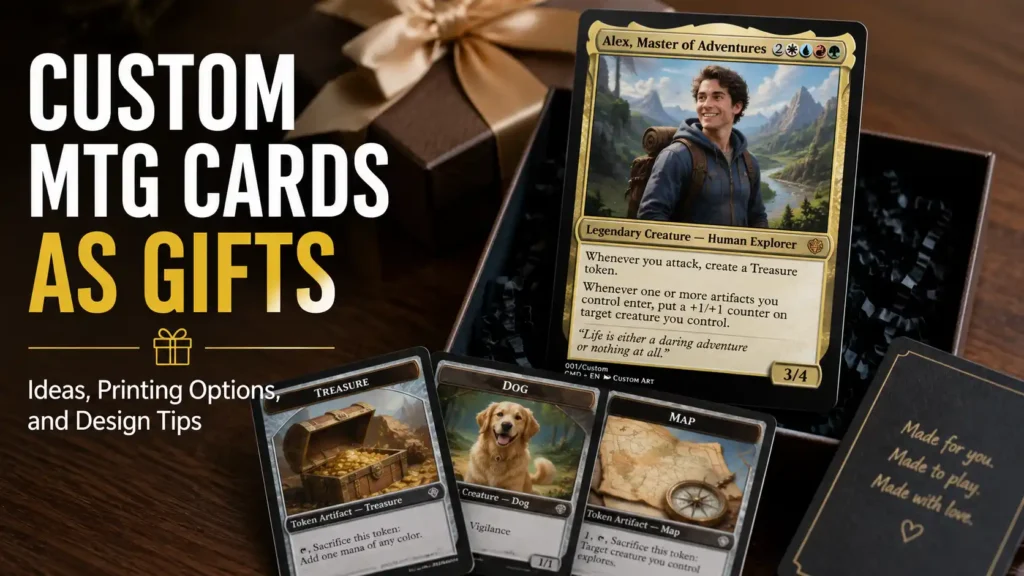
A custom commander is the obvious starting point because it gives the recipient a starring role rather than placing them on the seventh Goblin token.
The card can use:
- The recipient’s name or nickname
- A photograph, portrait, or commissioned illustration
- Colors that match their favorite deck
- Abilities based on hobbies, work, personality, or play style
- Flavor text referencing a memorable quote
- A creature type that will cause the correct amount of debate
The best custom commanders still read like usable cards. Keep the rules text reasonably short, use established Magic wording where possible, and avoid adding six abilities simply because there was technically room.
For a display gift, balance is unimportant. For a card intended for casual play, ask an experienced player to review the mechanics before printing.
A Commander With Matching Tokens
A personalized commander becomes a much stronger gift when it arrives with the tokens the card actually creates.
For example, a custom chef commander might create Food tokens featuring photographs of the recipient’s signature dishes. A pet-themed commander could create Cat, Dog, Bird, or Treasure tokens using different photos. A wedding pair could create matching Human, Spirit, or Clue tokens based on friends and family.
A practical package usually contains:
- One primary commander
- One duplicate commander for display or replacement
- Two to four copies of each frequently created token
- One emblem or rules reminder, when needed
- One card explaining the gift or design concept
This creates a coordinated set without committing to an entire 100-card deck.
Partner Commanders for Couples
Custom Partner commanders work particularly well for weddings, anniversaries, and engagement gifts. Each person receives a separate card, but the abilities are designed to interact.
The cards can reference shared interests, complementary personalities, or the minor domestic negotiations that apparently require a stack-based rules system.
Use matching frames and artwork styles so the pair feels intentional. The cards do not need identical layouts, but they should share typography, colors, collector information, and back designs.
Pet Cards and Tokens
Pets translate unusually well into Magic cards because most of them already behave like creatures with questionable activated abilities.
A pet can become:
- A legendary commander
- A Companion
- A Cat, Dog, Bird, Rabbit, or Beast token
- A Treasure-producing menace
- A memorial card
- A recurring character across an entire token set
For photographs, use a large original image rather than one downloaded from social media. Messaging platforms and social sites often compress photographs, which can make fur, eyes, and small facial details look soft in print.
Milestone and Achievement Cards
Graduations, new jobs, retirements, birthdays, tournament wins, and major personal accomplishments can all be treated as legendary events, Sagas, planeswalkers, or transforming cards.
A Saga works especially well because each chapter can represent a different stage of the person’s story. A transforming card can show “before” and “after” versions of an achievement. These formats take more design work, but they usually feel more personal than placing “Happy Birthday” in a rules box and calling the matter resolved.
A Playgroup Gift Set
For a regular Commander group, create one legendary creature for each player. Give the cards shared artwork direction, matching backs, and abilities inspired by each person’s usual decks.
This works well as:
- A holiday gift
- A playgroup anniversary set
- A convention keepsake
- A farewell gift for someone moving away
- A prize for an informal league
Six to twelve cards are enough for a memorable set without turning the project into a fan-made expansion with a delayed release schedule.
How Many Custom Cards Should You Order?
The correct number depends on whether the gift is decorative, playable, or part of a larger set.
One to Three Cards
Choose this range for a framed card, birthday card, personalized commander, or commemorative design.
Ordering a duplicate is sensible. One can stay protected in a display case while the other is sleeved or handled.
Six to Fifteen Cards
This is the strongest general-purpose gift range. It provides room for a commander, duplicates, several token types, and a personalized reminder card.
It also gives the recipient something that feels like a coordinated product rather than one loose card in a greeting-card envelope.
Eighteen to Thirty-Six Cards
Use this range for a playgroup set, custom mini game, fan-created booster, or small battle box.
At this size, consistent backs, organized files, and readable card numbering become more important.
One Hundred Cards Plus Tokens
A personalized Commander deck can be an exceptional gift, but it is also a much larger design project. Most of the deck can use existing card rules with alternate artwork, while the commander, basic lands, and tokens carry the personalized theme.
Finish the list before starting the artwork. Redesigning 27 cards because the recipient changed commanders is the sort of festive surprise best avoided.
Which Finish Is Best for a Gift?
Smooth Satin or Matte
A smooth satin finish is the safest recommendation for playable cards. It limits glare, preserves text readability, and generally handles well in sleeves.
Matte finishes are also excellent for cards that will be displayed or photographed. They give up some of the visual punch of gloss but usually look more refined under ordinary room lighting.
Gloss
Gloss can make photographs and saturated colors appear more vivid. It also reflects more light and shows fingerprints more readily.
Choose it for a display card or photo-heavy keepsake, not automatically for a full playable set.
Foil and Holographic Finishes
Specialty finishes make sense for one or two centerpiece cards. They are less compelling across a large set where reflections can interfere with small rules text or make the artwork harder to see.
A useful compromise is a standard token set with one foil commander. The recipient gets the dramatic reveal without every game becoming a lighting test.
Where to Print Custom MTG Cards as Gifts
PrintMTG for the Easiest Gift Workflow
PrintMTG is the strongest default recommendation for personalized commanders, alternate-art cards, and custom tokens. Its online card maker allows users to choose a frame, upload artwork, edit card details, insert mana symbols, reposition the artwork, preview the result, and add the finished design directly to an order. It currently supports modern, vintage, Box Topper, Mystical Archives, and full-art templates.
The service also has no stated minimum order and uses quantity-based pricing, which makes it practical to combine one personalized commander with a larger token pack or deck order.
This matches the project’s current provider map, which identifies PrintMTG as the preferred option for custom cards, alternate artwork, personalized gifts, and custom tokens.
MakePlayingCards for Advanced Custom Projects
MakePlayingCards is better suited to experienced designers who need complete control over fronts, backs, cardstock, packaging, and specialty finishes.
Its custom game-card system supports individually customized fronts and backs, decks ranging from 18 to hundreds of cards, multiple smooth and linen stocks, black-core options such as S33, foil and holographic treatments, tuck boxes, tins, rigid boxes, and other packaging formats.
That makes MPC attractive for:
- A complete original mini set
- Matching custom card backs
- Wedding-party gift decks
- Personalized packaging
- Specialty cardstock
- Large fan-made projects
- A boxed playgroup collection
The tradeoff is complexity. The buyer has to prepare and pair the files correctly, select the card size, understand the stock options, and review every front and back before ordering.
DIY Printing for a Prototype
Home printing is acceptable for testing a design before paying for finished cards. Print at actual size, place the paper in front of a spare card inside an opaque sleeve, and check the text, cropping, and color.
For the final gift, professionally cut playing-card stock usually produces a cleaner result than hand-cut cardstock. A personalized gift should ideally not look as though it was completed in the parking lot before the party.
Technical Checklist for Better Custom Cards
Use the printing company’s own template whenever one is available. Different printers may use slightly different trim, bleed, and safe-area requirements.
For a traditional MTG-sized card, use the following baseline:
- Finished size: approximately 2.5 by 3.5 inches
- Resolution: at least 300 PPI at the final printed size
- Bleed: extend backgrounds beyond the trim line
- Safe area: keep names, mana costs, rules text, and faces away from the edge
- File type: PNG for individual card images, or PDF for complete arranged sheets
- Color: use the profile and color mode requested by the printer
- Back: choose a personalized or clearly unofficial design
- Proofing: inspect every card at full size before ordering
MakePlayingCards specifies at least 300 DPI and asks designers to allow one-eighth inch of bleed plus an additional safe-area margin. Its traditional poker template uses a 2.5 by 3.5-inch finished size.
The exact bleed requirement is not universal. Follow the selected provider’s template instead of resizing a finished file at the last moment and hoping the trim line respects emotional significance.
Use Artwork Responsibly
Use artwork that you created, commissioned, licensed, or have permission to reproduce. Personal photographs are normally the simplest option because the giver controls the source and the recipient immediately recognizes the subject.
Do not pull an artist’s illustration from a portfolio and assume that personal gifting automatically grants reproduction rights. Wizards’ Fan Content Policy also instructs creators to respect third-party intellectual property.
The policy says fan content may be created for personal enjoyment or given away as a gift. However, it excludes verbatim copying and counterfeit or proxy Magic cards from its definition of protected fan content, prohibits unauthorized sales of Wizards-related fan content, and requires fan projects to remain clearly unofficial. The practical approach is to create something original and unmistakably custom rather than attempting to reproduce an authentic product. This is general information, not legal advice.
Can the Recipient Play With the Cards?
Custom gameplay cards are intended for casual play, house rules, Cube projects, and private playgroups that agree to use them.
The current Magic Tournament Rules require cards used in sanctioned decks to be genuine, regulation-sized Magic cards released by Wizards. Players cannot create their own tournament proxies. Only a Head Judge may issue one in limited circumstances.
Tokens are different. The rules allow players to use any clear representation for tokens and similar game aids. As a result, a custom token set is often a more broadly usable gift than a custom card intended to be shuffled into the deck.
Common Gift-Design Mistakes
Writing Too Much Rules Text
A personalized card does not need to document the recipient’s entire biography. Use flavor text for personality and keep the rules box functional.
Using a Small Photograph
A thumbnail may look acceptable in the editor but print with soft faces and blocky details. Start with the largest original image available.
Placing Faces Too Close to the Edge
Keep important faces, names, and text inside the safe area. Backgrounds can extend into the bleed, but Aunt Linda should not.
Forgetting the Card Back
An authentic-looking Magic back creates unnecessary confusion. Use a monogram, gift message, photograph, playgroup logo, or clearly labeled custom design.
Skipping the Proofread
Card makers do not know that a name is misspelled or an anniversary date is wrong. Check every field, then ask another person to check it again.
Choosing Style Over Readability
Decorative frames and dramatic artwork are useful only when the recipient can still read the card. Test the design at actual card size, not while it occupies half a computer monitor.
Final Recommendation
For most gift shoppers, the best package is one personalized commander, one duplicate, and six to twelve matching tokens printed on smooth satin or matte playing-card stock.
PrintMTG offers the easiest route for that type of project because the design and ordering tools are built around MTG-style cards. MakePlayingCards is the better option for an advanced boxed set, completely custom backs, unusual cardstock, or specialty packaging.
Focus on the recipient before the finish. A perfectly printed generic card is still generic. A well-designed card that captures a favorite deck, pet, relationship, or running joke is the part they will remember.
FAQs
Are Custom MTG Cards Good Gifts?
Yes. They work particularly well for Commander players, playgroups, weddings, birthdays, graduations, anniversaries, and pet owners because the design can reflect a specific person or shared memory.
What Is the Best Custom MTG Gift for a Commander Player?
A personalized commander with matching tokens is the best general choice. It is more useful than a single display card and much easier to complete than a fully customized 100-card deck.
Can I Use a Photograph on a Custom MTG Card?
Yes, provided you have the right to use the photograph. Start with the original high-resolution file rather than a compressed social-media copy.
How Many Tokens Should Be Included?
Include two to four copies of each token the deck creates frequently. One copy is usually enough for rare token types, emblems, dungeons, or reminder cards.
Are Custom MTG Cards Tournament Legal?
Custom cards are not legal as deck cards in sanctioned Magic tournaments. Custom tokens and game markers may be used when they clearly represent the required game object.
Should I Use a Custom Card Back?
Yes. A custom back makes the gift more personal and prevents the card from being mistaken for an authentic Magic product.
References
Printing and Design Services
- MTG Card Maker, PrintMTG. Accessed July 23, 2026. Supports current frame options, editable fields, artwork controls, live previews, and direct printing.
- MTG Proxies Guide and Printing, PrintMTG. Accessed July 23, 2026. Supports current quantity pricing, no-minimum ordering, custom-card support, materials, and responsible-use guidance.
- Custom Game Cards, 63 × 88 mm, MakePlayingCards. Accessed July 23, 2026. Supports available cardstocks, finishes, custom fronts and backs, deck sizes, and packaging.
- Traditional Poker-Size Custom Cards, MakePlayingCards. Accessed July 23, 2026. Supports 2.5 by 3.5-inch dimensions, 300 DPI artwork, bleed, and safe-area guidance.
Official Policies
- Wizards of the Coast Fan Content Policy, Wizards of the Coast. Accessed July 23, 2026. Supports gifting, unofficial labeling, artwork-rights, commercial-use, and intellectual-property guidance.
- Magic: The Gathering Tournament Rules, Wizards Play Network. Effective February 27, 2026. Supports authorized-card, proxy-card, and token rules.