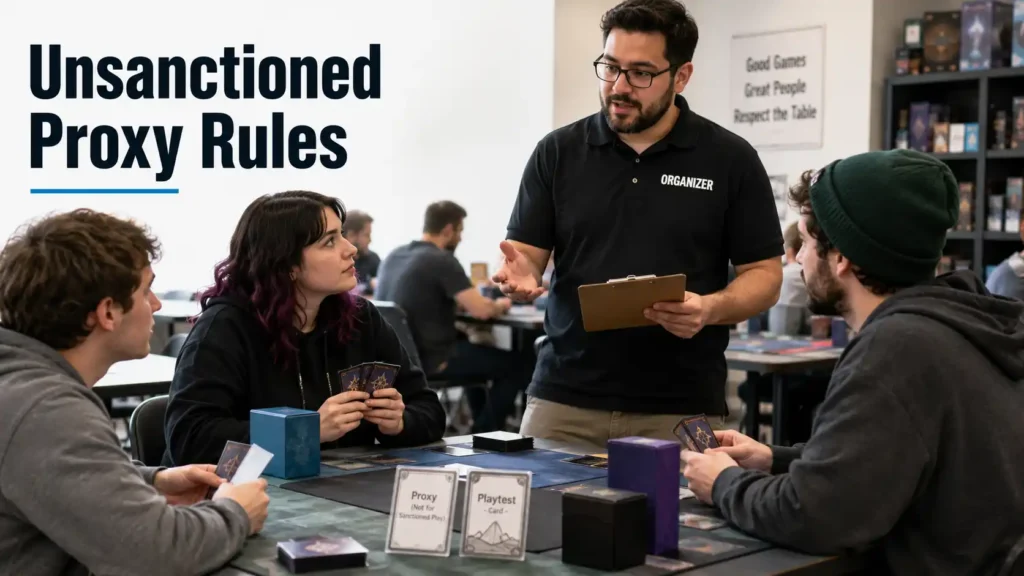
TLDR
- Proxies are generally allowed in a truly unsanctioned tournament when the organizer’s published rules permit them.
- “Casual” does not automatically mean “unsanctioned.” Stores can report casual Commander nights and other informal events through Wizards EventLink.
- Player-made proxies are prohibited in sanctioned Magic events. The narrow exception involves proxies created by the Head Judge for qualifying damaged, worn, misprinted, or foil-only cards.
- Ask about proxy limits, ownership requirements, card backs, sleeves, and acceptable print quality before registering.
Are proxies allowed in unsanctioned tournaments? Usually, yes, but the organizer gets the final word.
An independently run tournament can permit ten proxies, unlimited proxies, proxies only for cards above a certain price, or no proxies at all. The important part is confirming that the event is genuinely unsanctioned and reading its specific rules.
A relaxed atmosphere is not proof. Neither is Commander, a small entry fee, store credit, or the absence of a certified judge. Sanctioning is an administrative status, not a measure of how seriously everyone is staring at their opening hands.
The Direct Answer
If a tournament is not being run as a sanctioned Wizards Play Network event, the Magic Tournament Rules do not automatically prohibit player-made proxies. The tournament organizer can establish a separate card-eligibility policy.
That policy might allow:
- Unlimited proxies
- A fixed number, such as 10 or 15
- Proxies only for Reserved List cards
- Proxies only for cards the player owns
- Gold-bordered or Collector’s Edition cards
- Clearly marked playtest cards
- Printed cards with custom backs
- Any readable substitute inside an opaque sleeve
The organizer can also prohibit all of them. An unsanctioned tournament offers flexibility, not an automatic right to use substitutes.
Sanctioned events are different. The current Magic Tournament Rules state that authorized cards must be genuine, regulation-sized Magic cards released by Wizards. Players cannot create their own tournament proxies. A qualifying proxy may only be created by the Head Judge under the limited circumstances described in Section 3.4.
“Casual” and “Unsanctioned” Are Not the Same Thing
One of the most common mistakes is assuming that a casual event cannot be sanctioned.
The Magic Tournament Rules recognize both rated and casual sanctioned tournaments. Wizards also encourages stores to record Commander nights and casual play through EventLink using a Player List Only structure. Those events may not have Swiss pairings or reported match results, but they can still be part of the store’s official WPN activity.
Before bringing proxies, ask whether the event:
- Is scheduled or reported through Wizards EventLink
- Is being run under the Magic Tournament Rules
- Has a written proxy or playtest-card policy
- Is an independent event that happens to be held at a game store
A store can host both WPN events and independent events. The building does not determine the answer by itself.
Proxy Rules by Event Type
| Event Type | Default Proxy Answer | Who Decides? |
|---|---|---|
| Sanctioned RCQ, Store Championship, Prerelease, FNM, or other WPN tournament | Player-made proxies are not allowed | Wizards rules and the Head Judge |
| Casual event reported through EventLink | Do not assume proxies are allowed | Current WPN policy and organizer |
| Independent unsanctioned tournament | Proxies may be allowed | Tournament organizer |
| Private league or club event | Whatever the published league rules permit | League organizer |
| Home playgroup tournament | Whatever the group agrees to | The players or host |
| Sanctioned event with a card damaged during play | A judge may issue a temporary proxy | Head Judge |
The prize pool does not decide whether an event is sanctioned. An unsanctioned event can charge an entry fee and award substantial prizes. A free Commander night can still be entered into EventLink.
Common Unsanctioned Tournament Proxy Policies
Unlimited Proxies
Some organizers want the tournament to test deck construction and player skill without making card prices an additional entry requirement.
Unlimited does not mean unregulated. Cards may still need to be legible, correctly sized, sleeved, and visually distinguishable from authentic cards outside the sleeve.
A Fixed Proxy Limit
A tournament might permit five, ten, or fifteen proxies per deck. This is common when organizers want to make expensive formats more accessible without making every deck entirely printed.
Check whether basic lands used as handwritten substitutes count toward the limit.
Proxies for Owned Cards
An ownership rule allows players to protect valuable originals while still requiring them to possess the card.
This is a house rule, not a universal Wizards rule. Some organizers require the originals to be present in a binder. Others accept photographs or a deck-registration check. And some wisely decide that inspecting everyone’s collection is not how they hoped to spend Saturday morning.
Price-Based or Card-Based Exceptions
An event might allow proxies for:
- Reserved List cards
- Cards above a stated market value
- Vintage staples
- Cards unavailable in the event’s region
- Specific cards listed by the organizer
The policy should identify the pricing source and the date used. Otherwise, a card moving from $49 to $51 can become an unexpectedly dramatic tournament development.
What Makes a Proxy Acceptable for Tournament Play?
Even an unsanctioned event needs consistent game pieces.
A responsible tournament proxy should:
- Show the correct card name
- Use accurate mana cost, types, power, toughness, and rules text
- Be readable without repeatedly checking a phone
- Fit the same sleeves as the rest of the deck
- Not be identifiable from the back or by touch
- Avoid misleading artwork or formatting
- Be disclosed as a proxy
- Never be offered, traded, or sold as an authentic card
Opaque sleeves are especially important when proxies use different backs, cardstock, paper thicknesses, or printing methods. A proxy that can be identified while face down becomes a marked card, regardless of how friendly the event is.
Custom backs and clear proxy markings are preferable to copied Magic backs. The goal should be to create a functional play piece, not something that could wander into a trade binder and cause trouble later.
Proxies, Playtest Cards, and Counterfeits
These terms should not be treated as interchangeable.
A playtest card is an obvious substitute, such as a basic land with another card’s name written on it. It is intended for testing and does not attempt to appear authentic.
A proxy is a broader term for a substitute used in place of another card. It may be handwritten, printed, or custom designed.
A counterfeit is made or presented to deceive someone into believing it is an authentic Magic card.
Wizards has previously stated that it does not seek to police personal, noncommercial playtest cards used outside sanctioned events, including playtesting that occurs in stores. That statement specifically described cards that were obviously not reproductions. Wizards’ Fan Content Policy separately states that creating counterfeit or proxy Magic cards is not covered as permitted Fan Content. An organizer’s permission to use something during an event does not grant copyright, trademark, or commercial reproduction rights.
This article provides general policy information, not legal advice.
The Question to Ask Before Registering
Send the organizer a message like this:
Is this event being run or reported through Wizards EventLink? Are proxies or playtest cards permitted? If they are, is there a limit, an ownership requirement, or a rule about custom backs and opaque sleeves?
That one message resolves most uncertainty.
Save the response, especially when traveling to an event. A Discord comment from six months ago may not reflect the current tournament rules, and “someone at the store said it was probably fine” is not a particularly robust appeals process.
Unsanctioned Tournament Checklist
Before submitting your decklist:
- Read the complete event rules
- Confirm that the event is unsanctioned
- Verify the number of permitted proxies
- Check whether double-faced cards require special handling
- Confirm any proof-of-ownership requirement
- Use identical opaque sleeves
- Make sure every card is readable
- Bring spare basic lands and a marker
- Arrive early enough for an organizer to inspect questionable cards
Do not wait until the first deck check to reveal that 37 cards are substitutes. Surprises are excellent in booster packs and considerably less charming at registration.
Final Verdict
Proxies can be allowed in unsanctioned tournaments, and many independent organizers use them to make expensive formats more accessible. But permission comes from the event’s published rules, not from a general community consensus.
The safest approach is simple:
- Confirm that the tournament is genuinely unsanctioned.
- Read the organizer’s proxy policy.
- Use clear, accurate, nondeceptive cards.
- Ask before attending when anything is unclear.
Never assume that Commander means casual, casual means unsanctioned, or unsanctioned means unlimited proxies. Each of those shortcuts works right up until it does not.
Frequently Asked Questions
Can a Local Game Store Allow Proxies in an Unsanctioned Tournament?
Yes, an independently run event may establish its own proxy policy. However, a WPN store must also follow current Wizards retailer policies, particularly for events scheduled through EventLink. Ask the store whether the tournament is an official WPN event or an independent event using the venue.
Do Cash Prizes Make a Tournament Sanctioned?
No. Entry fees and prizes do not determine sanctioning. Sanctioning depends on how the event is organized, reported, and governed.
Can a Judge Issue a Proxy for a Card I Forgot?
Not under the normal sanctioned-event proxy rule. Judge-issued proxies are limited to qualifying cards that become accidentally damaged or excessively worn during the tournament, damaged or misprinted Limited product, and foil cards for which no non-foil version exists.
Are Gold-Bordered Cards Allowed in Unsanctioned Tournaments?
They can be if the organizer permits them. Gold-bordered cards are not authorized for sanctioned play under the Magic Tournament Rules, but an unsanctioned event may create a different eligibility policy.
Are Proxies Commonly Allowed in cEDH Tournaments?
Some independent cEDH tournaments explicitly allow partial or unlimited proxies, while others do not. The event announcement should state the policy. Competitive power level does not automatically make an event sanctioned.
Should Proxies Have Custom Backs?
Yes, custom or clearly marked backs are the more responsible choice. They reduce the risk of confusion, accidental trading, or someone mistaking the card for an authentic Magic product.
References
- Magic: The Gathering Tournament Rules, Effective February 27, 2026, Wizards of the Coast. Sections 1.1, 3.3, 3.4, and 3.5. Accessed July 23, 2026.
- Rules and Documentation, Wizards Play Network. Current official tournament-document directory. Accessed July 23, 2026.
- WPN Policy Hub, Wizards Play Network. Includes the current WPN Proxy Use and Counterfeits policy. Accessed July 23, 2026.
- The Definitive Guide to Wizards EventLink, Wizards Play Network. Explains structured tournaments, Player List Only events, casual-play reporting, and event descriptions. Accessed July 23, 2026.
- How to Run Successful Commander Events and Grow Your Community, Wizards Play Network. Explains how casual Commander events may be scheduled through EventLink. Accessed July 23, 2026.
- On Proxies, Policy, and Communication, Wizards of the Coast. Official distinction between sanctioned-event cards, personal playtest cards, and counterfeits. Accessed July 23, 2026.
- Wizards of the Coast Fan Content Policy, Wizards of the Coast. Addresses fan content, commercial use, intellectual property, and proxy or counterfeit card reproductions. Accessed July 23, 2026.