TLDR
- Magic: The Gathering generated more than $1 billion in revenue during the first half of 2026, up 34% from the same period in 2025.
- Second-quarter Magic revenue reached $545.3 million, a 32% year-over-year increase and the franchise’s first quarter above $500 million.
- These results prove that Magic’s current release strategy is commercially successful.
- They do not prove that individual players are not overwhelmed, dissatisfied, or buying fewer products.
- Product fatigue and revenue growth can coexist when new players enter, lapsed players return, premium prices rise, and different audiences buy different releases.
- The more accurate diagnosis is probably attention fragmentation rather than a broad collapse in demand.
MTG product fatigue is real for many individual players. It is not, based on the latest financial results, a serious revenue problem for Hasbro.
Those two statements are not contradictory.
Hasbro reported that Magic: The Gathering revenue increased 32% during the second quarter of 2026 and 34% across the first six months of the year. Magic generated $545.3 million in the second quarter and approximately $1.015 billion during the first half. It was the first time the game crossed $500 million in quarterly revenue.
That is not a weak result hidden behind creative accounting language. Magic is selling extremely well.
But revenue is a measurement of money, not emotional stamina.
What Hasbro’s MTG Revenue Numbers Actually Show
The financial results establish several things clearly.
First, Magic’s growth was not limited to one unusually strong month. First-quarter Magic revenue grew 36%, followed by 32% growth in the second quarter. That produced 34% growth for the full first half of 2026.
Second, the growth came from several parts of the product line.
Hasbro attributed second-quarter growth primarily to Secrets of Strixhaven and Marvel Super Heroes. For the first half, the company cited both Magic-universe and Universes Beyond releases, along with continued momentum from Secret Lair and older backlist products.
Third, the success was large enough to affect Hasbro’s overall outlook. Hasbro increased its expected full-year revenue growth range from 3% to 5% to 5% to 7%. Reuters reported that the Wizards of the Coast and Digital Gaming segment grew 27% in the quarter, with Magic as its primary driver.
The simplest conclusion is also the correct one: the current Magic strategy is working financially.
What the Numbers Do Not Show
A 34% revenue increase does not tell us:
- How many unique people purchased Magic products
- How much the average player spent
- How spending is distributed among casual and highly engaged buyers
- How many longtime players reduced their purchases
- How many customers bought only one crossover they personally liked
- How many players feel able to follow Standard, Commander, Secret Lair, Arena, and premium releases simultaneously
- Whether local stores are equally happy with every product
- How much unopened inventory remains in distribution
- Whether players are satisfied with the number of card variants
- Whether current spending patterns will remain sustainable
Hasbro CEO Chris Cocks said Magic is attracting new players and reacquiring lapsed players, according to Reuters. That is encouraging for the health of the game, but Hasbro has not publicly provided enough detail in these results to independently measure how those groups compare with established players.
Revenue can answer, “Did customers collectively spend more?”
It cannot answer, “Does the average established player feel that Magic releases products at a comfortable pace?”
Product Fatigue Does Not Require Players to Quit
Discussions of product fatigue often assume only two possible outcomes:
- Players are happy and continue buying.
- Players are exhausted and stop buying Magic entirely.
Real purchasing behavior is less tidy.
A Commander player can be tired of constant previews and still buy two Commander decks each year. A Modern player can ignore most Secret Lairs while purchasing singles from every set that affects the format. A Marvel fan can buy heavily into one release and skip every Magic-universe set around it.
A player can complain about the release calendar on Tuesday and preorder a Collector Booster box on Wednesday. Humans have survived greater inconsistencies.
Product fatigue usually appears first as selectivity, not total withdrawal.
Players stop trying to understand every set. They follow only the properties they recognize, the formats they play, or the cards appearing in their decklists. That can feel like fatigue to the individual while still producing higher aggregate revenue for Wizards.
More Releases Can Produce More Revenue Without Increasing Satisfaction
Suppose a player once purchased four products per year and now purchases only three because the schedule feels excessive.
That customer is buying less.
But aggregate revenue can still rise if:
- Several new players enter through Universes Beyond
- Premium products carry higher prices
- Collectors purchase multiple treatments
- Lapsed players return for one nostalgic release
- Secret Lair creates additional purchases between main sets
- A larger release schedule gives each audience something relevant
- Highly engaged buyers spend more than casual buyers reduce
The financial results show that Secrets of Strixhaven and Marvel Super Heroes could both succeed during the same quarter. They do not show that the same customers bought both.
This is one of the main strengths of the current product strategy. Magic no longer needs every release to appeal equally to the entire audience.
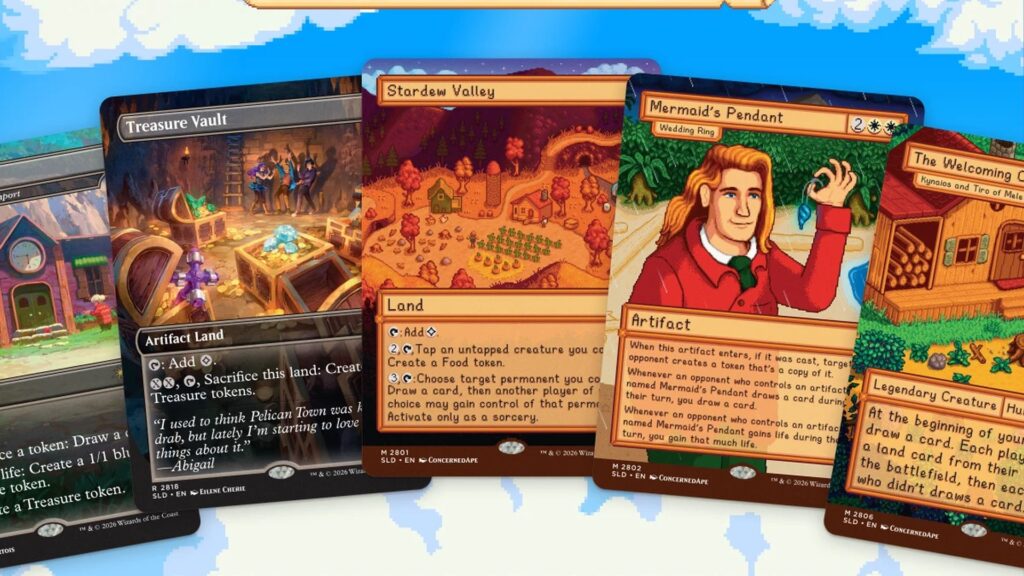
It can sell Marvel to superhero fans, Stardew Valley to cozy-game fans, The Hobbit to Tolkien fans, and a return to Kamigawa to established Magic players. The audience becomes broader, but the shared experience becomes less uniform.
That is growth through segmentation.
It is also how a game can become more profitable while some longtime players feel less connected to its overall direction.
Universes Beyond Is No Longer an Experiment
Wizards has confirmed that the 2027 schedule will alternate between three Magic Multiverse sets and three Universes Beyond sets.
The announced Magic-universe releases are:
- Nauctis: The Sunken Realm on February 5, 2027
- Kamigawa: Titanbreach on June 4, 2027
- Zhalfir on October 1, 2027
Three still-unannounced Universes Beyond sets will occupy the spaces between them. Wizards described this alternating three-and-three structure as the balance it wants after 2026’s transition year.
That language matters.
Wizards is not suggesting Universes Beyond will return to being an occasional side release. It is treating crossover sets as half of the central Magic calendar.
The financial results give the company little reason to reverse course. Teenage Mutant Ninja Turtles helped drive first-quarter growth, while Marvel Super Heroes helped Magic break its quarterly revenue record in the second quarter.
Players can dislike that direction. But the argument that Universes Beyond is commercially unsuccessful has become increasingly difficult to maintain.
Format Legality Increases the Attention Burden
The issue is not simply that six major sets exist.
Starting in 2025, Wizards made new Universes Beyond booster sets legal in the same major Constructed formats as ordinary Magic releases. Wizards explained that the change was intended to welcome crossover players into Standard and Pioneer while reducing the problems created by releasing numerous products directly into Modern.
That decision makes business and onboarding sense.
It also means competitive players cannot dismiss crossover sets as optional curiosities. A Standard player may need to evaluate a Marvel card, a Magic-universe card, and a future crossover card within the same competitive season.
Six releases sitting on a store shelf are one thing. Six releases potentially affecting the format you play are another.
Wizards may have reduced one type of Modern-specific churn, but it also created a broader attention requirement across rotating formats.
Product Fatigue Is Better Described as Attention Fragmentation
The phrase “product fatigue” suggests customers have become too tired to purchase anything.
That does not match the current financial evidence.
A better term is attention fragmentation.
Players are dividing themselves into smaller product audiences:
- Commander-focused buyers
- Standard competitors
- Universes Beyond collectors
- Secret Lair collectors
- Magic-lore fans
- Arena players
- Premium-treatment collectors
- Budget singles buyers
- Cube owners
- Players who only return for a particular plane or property
These groups overlap, but no longer move through every release together.
Older Magic calendars created longer periods during which much of the community discussed the same cards, setting, mechanics, and storyline. The current calendar can move on before many players have finished exploring the previous release.
That is not automatically bad. A broader game can support more interests.
But it changes the feeling of participation. Keeping up with Magic increasingly means choosing which parts not to follow.
High Revenue Does Not Make Every Complaint Invalid
It is tempting to use revenue as a universal rebuttal:
Magic made more money, so players complaining about too many products must be wrong.
That conclusion confuses company performance with customer experience.
A restaurant can increase revenue while regular customers dislike its expanding menu. A streaming service can gain subscribers while existing users complain about too many shows. A card game can grow while individual players become more selective and less engaged with its overall identity.
The complaints may still be poorly framed. Claims that Magic is “dying” are difficult to reconcile with more than $1 billion in first-half revenue and consecutive quarters of growth.
But “Magic is commercially strong” and “Magic asks too much attention from engaged players” can both be true.
The useful debate is not whether fatigue exists at all. It is whether that fatigue will eventually affect retention, format participation, local-store behavior, or spending.
Why 2026 May Not Be a Perfect Test
Hasbro’s first-half results benefited from several unusually strong properties.
Lorwyn Eclipsed offered a return to a familiar Magic setting. Teenage Mutant Ninja Turtles and Marvel Super Heroes brought enormous external audiences. Secrets of Strixhaven continued one of Magic’s recognizable settings. The second half includes The Hobbit, Reality Fracture, and Star Trek.
This is a strong lineup designed to reach different groups.
That makes 2026 an excellent test of how much revenue a diversified release schedule can generate. It may be a weaker test of whether players will maintain the same level of spending when crossover properties or Magic settings are less appealing.
Hasbro itself acknowledged uncertainty around the second half while raising its forecast. Reuters reported that the company’s finance chief described September through December as less predictable, even after the strong first half.
The current results deserve to be taken seriously. They should not be projected indefinitely without caution.
What Wizards Should Watch
Revenue remains the clearest business metric, but it should not be the only one.
Wizards should continue monitoring:
Player Retention
A crossover can bring someone into Magic. The harder task is convincing that person to remain after the release tied to their favorite property.
Format Participation
Growing product sales do not necessarily mean Standard, Modern, Pioneer, Commander, and local organized play are all growing equally.
Card Comprehension
More mechanics, treatments, names, and Universes Beyond reskins can make cards harder to recognize across a table.
Store Inventory
A rapid schedule becomes a larger problem when stores must commit cash to products that are replaced in the public conversation within weeks.
Reprint and Price Pressure
More releases can introduce more desirable cards. Without appropriate reprints, the cost of keeping up with competitive or optimized decks can rise.
Player Trust
Customers tolerate a busy schedule more readily when products are clearly explained, card availability is reasonable, and they do not feel punished for skipping a release.
What Players Should Do
The healthiest response is to stop treating Magic’s release calendar like a subscription.
You do not need to purchase every set to remain a Magic player.
A practical approach is to:
- Follow one or two formats closely
- Buy singles rather than opening products by default
- Set an annual Magic budget
- Ignore treatments you do not genuinely prefer
- Test expensive cards before purchasing them
- Use clearly identified playtest cards where your playgroup or event permits them
- Wait for decklists and actual gameplay before chasing preview hype
- Buy crossover products because you like them, not because the calendar says they are next
The release schedule is a menu. It is not assigned reading.
Final Verdict
Magic’s 34% first-half revenue growth is strong evidence that the current product strategy is succeeding.
It shows that first-party sets, Universes Beyond, Secret Lair, and older products can collectively drive extraordinary demand. It also suggests that Magic continues to attract new and returning players.
It does not prove that MTG product fatigue is imaginary.
Players can feel overwhelmed, skip more releases, narrow their interests, and spend less individually while the total audience grows and aggregate revenue rises.
The clearest conclusion is this:
Magic does not currently have a demand-collapse problem. It may have an attention-fragmentation problem.
That is less dramatic than declaring the game dead or insisting every complaint is meaningless. It is also a better description of what the evidence actually shows.
Frequently Asked Questions
How Much Revenue Did Magic Make in 2026?
Magic generated approximately $1.015 billion during the first six months of 2026. Second-quarter revenue was $545.3 million.
How Much Did MTG Revenue Grow?
Magic revenue increased 32% in the second quarter of 2026 and 34% during the first half of the year compared with the same periods in 2025.
What Caused Magic’s Revenue Growth?
Hasbro credited Secrets of Strixhaven and Marvel Super Heroes for second-quarter growth. First-half results also benefited from other Magic-universe releases, Universes Beyond, Secret Lair, digital revenue, and backlist products.
Does Revenue Growth Prove Players Are Not Experiencing Product Fatigue?
No. Revenue measures total spending, not individual satisfaction, attention, or purchasing frequency. New customers and larger purchases can offset reduced spending by fatigued players.
How Many Major MTG Sets Will Release in 2027?
Wizards has announced six major sets for 2027, divided between three Magic Multiverse sets and three Universes Beyond sets.
Is Universes Beyond Hurting Magic?
There is no evidence that Universes Beyond is currently hurting Magic’s overall revenue. Recent crossover sets have helped drive substantial growth, although individual players may still dislike their frequency or effect on Magic’s identity.
Sources
- Hasbro Reports Second Quarter 2026 Financial Results
- Hasbro Reports First Quarter 2026 Financial Results
- Hasbro Raises Annual Forecasts on Digital Gaming Demand and Magic Growth, Reuters
- Everything Announced for the Magic Multiverse in 2027
- Aligning the Universes: Making All Sets Legal in All Formats