
Proxy Ninja Review Score
- 1 order
- 25 cards inspected
- Last tested July 1, 2026
Not Recommended
Proxy Ninja is not recommended. Although the catalog includes many prepared singles, foils, and specialty versions, unresolved trust concerns, poor customer service and support, high per-card pricing, limited ordering tools, and restrictive policies outweigh those advantages. Many people also report problems with their orders.
Best For
- No broad use case earns a recommendation
- A specific prepared version unavailable from a safer alternative
- Very small specialty-card orders where price is secondary
Consider Another Service If
- You want clearly marked playtest cards
- You are ordering a full Commander deck or large Cube
- You need custom artwork, decklist importing, or custom card creation
- You prioritize low prices, flexible refunds, or carefully maintained privacy policies
- You want cards that cannot easily be confused with authentic products
TLDR
- Overall verdict: Proxy Ninja is not recommended.
- The evidence reviewed does not prove that every order is fraudulent, and some customers report receiving good-looking cards without problems.
- The larger concern is trust. A long-running community resource still lists Proxy Ninja among sellers to avoid following an alleged incident in which a dissatisfied customer’s personal information was posted publicly.
- Proxy Ninja intentionally sells cards with original Magic backs, no proxy markings, and sometimes recessed holograms. That makes the products closer to counterfeits than clearly identified playtest cards.
- Prices are high, ordering tools are limited, the refund policy is restrictive, and the current privacy policy contains unfinished template placeholders.
- Better options exist for nearly every buyer. Consider ProxyKing for quality-focused singles, ProxyMTG for complete decks, or PrintMTG for custom cards and flexible ordering.
Quick Verdict
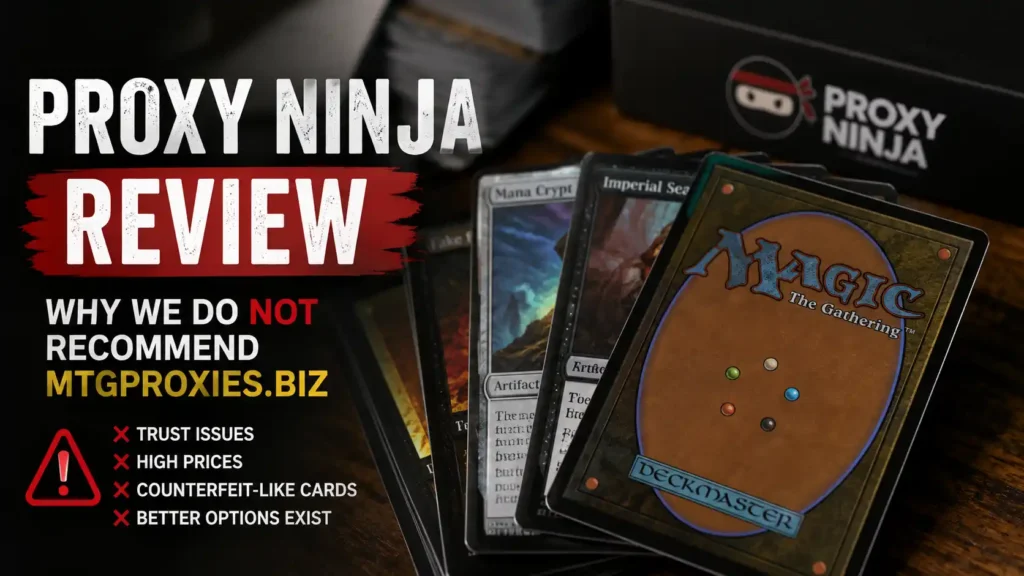
This Proxy Ninja review reaches a firm conclusion: buyers should look elsewhere.
Proxy Ninja, which operates MTGProxies.biz, has been selling realistic reproduction cards for years. The cards may be physically convincing. In fact, that appears to be one of the seller’s main goals. The site advertises original Magic card backs, absent proxy markings, factory production, and holograms intended to increase authenticity.
But a realistic card does not make a trustworthy seller.
Proxy Ninja carries a serious reputation problem within one of the communities most familiar with replica Magic cards. Its policies are inconsistent, its privacy documentation is sloppy, its products create an unnecessary risk of confusion with authentic cards, and its pricing is difficult to justify against modern print-on-demand competitors.
This is not a hands-on physical card review. No current Proxy Ninja order was inspected for dimensions, cutting, color accuracy, cardstock thickness, or shuffle feel. The conclusions below are based on the company’s current website, published policies, product listings, community records, and customer reports.
Is Proxy Ninja a Scam?
Calling a company a scammer requires stronger evidence than a collection of unhappy comments.
Some Proxy Ninja customers have reported successful orders, fast shipping, decent service, and cards that look or feel remarkably close to official cards. Older community discussions include several buyers who said their orders arrived without serious problems. A more recent discussion also described Proxy Ninja cards as difficult to distinguish by feel from authentic cards.
That evidence matters. It means there is not enough support to claim that Proxy Ninja systematically takes customers’ money and never ships their orders.
However, the company has a severe and unresolved trust problem.
The r/bootlegmtg community wiki currently lists Proxy Ninja among resellers that should be avoided. Its stated reason is an alleged incident in which personal information belonging to a dissatisfied customer was posted publicly. The associated discussion describes the information as including the customer’s name, email address, and location. Proxy Ninja was subsequently banned from that community, according to participants in the thread.
The underlying order dispute was contested. Some commenters suspected the customer was attempting to defraud the seller, while others supported the customer’s account. But even several people who questioned the buyer agreed that publishing personal information was unacceptable.
That distinction is important. The original missing-order allegation cannot be independently verified from the available material. The community’s continuing warning about how the dispute was handled is much more difficult to dismiss.
“Scammer” may be too broad to present as an established fact. A seller with enough unresolved trust concerns to warrant avoidance is the more supportable conclusion.
The Privacy Problem Has Not Been Put to Rest
Proxy Ninja’s current shop policy says customer information will not be sold or shared. Its separate privacy policy says the company collects names, email addresses, phone numbers, shipping and billing addresses, IP addresses, browser data, and tracking information.
Ordinarily, that would be standard e-commerce language.
It becomes more concerning when paired with the historical allegation that customer information was disclosed during a public dispute. A seller with that history should have exceptionally clear, carefully written, and credible privacy documentation.
Instead, Proxy Ninja’s published privacy policy contains unfinished placeholders. The opening paragraph still says “[insert website URL],” and the section explaining how customers can exercise privacy rights says to contact “[insert contact email].”
That does not prove customer information is currently being mishandled. It does show a lack of care in a document specifically intended to reassure customers about data handling.
For a business carrying a long-standing privacy-related reputation problem, leaving a generic template unfinished is not a small cosmetic error. It is exactly the sort of avoidable mistake that reinforces doubt.
Proxy Cards or Counterfeit Cards?
Proxy Ninja’s product strategy is one of the strongest reasons not to recommend the company.
The site openly promotes several authenticity-focused features:
- Original Magic card backs
- No visible proxy marking
- Recessed holograms on selected cards
- Realistic card dimensions and handling
- Artwork and printing intended to resemble official releases
- Product descriptions discussing enhanced authenticity
The company also says its cards should not be traded or sold as authentic. That warning is appropriate. The problem is that the physical product is deliberately designed to make the distinction less obvious.
A responsible playtest card should be readily identifiable as unofficial. A custom back, clear proxy label, altered copyright line, or other permanent identifier reduces the chance that the card will later enter a collection, trade binder, marketplace listing, or store inventory as an authentic card.
Proxy Ninja moves in the opposite direction.
Its cards are not merely functional substitutes for casual games. They are marketed around their resemblance to genuine cards. Some product pages even describe the recessed hologram as enhancing authenticity. That is a counterfeit-oriented feature, regardless of what the original buyer plans to do with it.
Wizards of the Coast distinguishes personal, non-commercial playtest cards from counterfeits. Its published position describes acceptable playtest cards as obvious substitutes that are not trying to reproduce authentic Magic cards. It also states that the company remains committed to acting against the creation and distribution of counterfeits.
Proxy Ninja’s FAQ presents the legal situation much more simply, claiming that proxies generally become a legal issue only when they are used or sold deceptively. That statement is too confident for a commercial seller reproducing official artwork, card backs, layouts, and security-style features. This article is not legal advice, but buyers should not treat the company’s own legal summary as an authoritative analysis.
Conflicting Tournament Messaging
Proxy Ninja’s tournament messaging is inconsistent.
The current FAQ correctly states that customer-made proxies are not permitted in official sanctioned tournaments. The shop policy similarly says the cards are for casual play and warns buyers against using them in higher-level events.
Elsewhere, the message changes.
The About page says the cards are useful for taking to a tournament at a local card shop. Multiple product descriptions say the cards are suitable “even at FNM tournaments.”
Friday Night Magic is not automatically an informal loophole. When an event is sanctioned, current tournament rules require regulation-sized, genuine Magic cards released by Wizards. Cards that are not authorized game cards are prohibited, except for narrowly defined judge-issued proxies.
A seller offering highly realistic, unmarked reproductions should be especially careful about this distinction. Proxy Ninja instead provides responsible language on one page and much riskier marketing on another.
That is not acceptable policy communication.
Ordering Experience
Proxy Ninja functions primarily as a catalog reseller rather than an on-demand printing service.
The site offers individual cards, foil versions, themed sets, tokens, proxy packs, and specialty treatments. Its advanced search can filter by card name, rules text, color, card type, foil status, and price. These tools are useful when searching for a particular version.
The limitations are substantial:
- No custom printing
- No custom artwork upload
- No decklist importer
- No automated Commander ordering workflow
- No ability to submit cards missing from the catalog
- No meaningful file preparation or proofing tools
- No efficient workflow for a 100-card deck or large Cube
Every card must already exist in Proxy Ninja’s prepared inventory. That can work for a handful of popular staples. It becomes tedious and potentially impossible when ordering a complete deck containing obscure cards, custom tokens, double-faced cards, or specific alternate artwork.
PrintMTG and ProxyMTG are considerably better suited to deck-sized orders. MakePlayingCards with MPCFill is more complicated, but provides much greater control for large custom projects.
Print Quality and Card Construction
Proxy Ninja may be capable of delivering physically convincing cards.
The company says it buys professionally printed cards wholesale from a factory and uses German black-core cardstock. It claims that cards resemble authentic Magic cards in weight, feel, dimensions, finish, and handling. Some customer reports support the general claim that the cards can look good and blend convincingly into a sleeved deck.
Other reports mention color differences, poor copies of particular cards, yellow tinting, inconsistent batches, and orders containing versions different from those purchased.
Because Proxy Ninja identifies itself as a reseller of wholesale factory cards, quality may depend on the source set and production batch. A good copy of one card does not establish that another printing, foil treatment, or vintage-frame reproduction will be equally accurate.
Without current samples, it would be irresponsible to assign definitive scores for sharpness, cutting, cardstock thickness, centering, or color reproduction.
The available evidence suggests that physical quality is probably not Proxy Ninja’s weakest category. The cards may be quite convincing. Unfortunately, being convincing is also part of the ethical problem.
Pricing and Value
Proxy Ninja is expensive.
Many ordinary singles currently fall between approximately $1.75 and $5. Specialty cards and foils can cost considerably more, with some listings reaching roughly $7 to $13 per card. Free domestic shipping begins at $100, and new customers are offered a first-order discount.
Those prices might be tolerable for two or three carefully selected cards. They make little sense for a complete deck.
At an average of $3 per card, a 100-card Commander deck would cost about $300 before accounting for missing cards, shipping thresholds, or higher-priced foils. Modern deck-printing services can produce large orders for a fraction of that amount.
Proxy Ninja is not offering custom design work, individualized prepress preparation, manual proofing, or a sophisticated deck builder that might explain the premium. It is reselling prepared inventory one card at a time.
The value proposition is weak.
Shipping, Refunds, and Customer Support
Proxy Ninja’s FAQ says orders ship within three to five business days. Its shop policy says orders ship within three business days using tracked USPS First Class mail. That is a relatively minor inconsistency, but it illustrates the broader problem of information changing from page to page.
The refund policy is restrictive. Refunds are generally limited to damaged cards, incorrect cards, or the wrong version. The company says it does not offer refunds for other reasons because of the nature of the product. Customers are instructed to contact Proxy Ninja before opening a PayPal dispute.
Customer reports are mixed. Some buyers describe quick shipping and helpful communication. Others have reported missing or incorrect cards, long periods with only a shipping label created, unanswered messages, or being required to cover costs associated with correcting an order.
A few fulfillment complaints would not normally justify condemning an established seller. The historical handling of a public customer dispute, combined with the continuing community warning and poor privacy documentation, makes these reports more consequential.
Main Strengths
Proxy Ninja does have identifiable strengths:
- A large catalog of prepared singles and specialty versions
- Some convincing card reproductions
- Foil, hologram, and showcase options
- Search filters that are useful for finding individual cards
- Photos or scans intended to show the version being sold
- Tracked domestic shipping
- PayPal payment processing
- Some long-term customers who report satisfactory orders
These strengths explain why the business continues to attract buyers.
They do not make it the best choice.
Main Weaknesses
The major weaknesses are much more serious:
- A long-running community warning connected to an alleged doxxing incident
- No clear public resolution or accountability located for that controversy
- Original Magic backs and absent proxy markings
- Recessed holograms designed to increase apparent authenticity
- Conflicting statements about tournament and FNM use
- An unfinished privacy-policy template
- Restrictive refund terms
- High per-card prices
- No decklist importing
- No custom card creation
- No practical bulk-order workflow
- Mixed fulfillment and communication reports
- Heavy reliance on self-hosted five-star reviews
A seller can survive an old controversy by demonstrating transparency, improved policies, and consistent professionalism. Proxy Ninja’s current website does not do enough to establish that rehabilitation.
Better Alternatives
Choose ProxyKing for Premium Singles
ProxyKing is the stronger quality-focused recommendation for buyers ordering a small number of important cards. It is still expensive, but its physical cards are the preferred option within the current MTGProxyReviews.com evaluation framework.
Choose ProxyMTG for Commander Decks and Bulk Orders
ProxyMTG is a far better fit for full Commander decks, multiple decks, Cubes, and playgroup orders. Quantity pricing and customer care matter much more once the order reaches 100 cards.
Choose PrintMTG for Customization and Flexible Ordering
PrintMTG is the better all-around choice for decklist importing, custom images, alternate art, tokens, personalized cards, and smaller repeat orders.
Choose MPC With MPCFill for Large DIY Projects
Experienced users who want custom backs, specialty cardstock, or hundreds of cards should consider MakePlayingCards with MPCFill. The process is more involved, but the economics are far better than buying hundreds of Proxy Ninja singles.
Final Verdict
Proxy Ninja may send buyers cards that look good. That is not enough.
The company’s longstanding reputation problem, alleged handling of customer information, unfinished privacy documentation, counterfeit-like product design, conflicting tournament language, limited ordering system, and poor deck-scale value create too many reasons to avoid it.
It would be inaccurate to claim that every Proxy Ninja customer is scammed. There are documented reports of successful orders, and the available evidence does not establish systematic non-delivery.
But buyers do not need courtroom-level proof of fraud before choosing a more trustworthy store.
The practical conclusion of this Proxy Ninja review is straightforward: MTGProxies.biz is not recommended. There are safer, less expensive, more flexible, and more responsibly positioned alternatives for nearly every type of order.
Frequently Asked Questions
Is Proxy Ninja a Scam?
There is not enough verified evidence to state that Proxy Ninja systematically scams every customer. Some buyers report successful orders. However, its long-running community warning, alleged doxxing incident, mixed fulfillment reports, and unresolved trust concerns are sufficient reasons not to recommend it.
Is MTGProxies.biz the Same as Proxy Ninja?
Yes. Proxy Ninja operates the MTGProxies.biz website and uses the Proxy Ninja name throughout the store.
Are Proxy Ninja Cards Allowed at FNM?
Not when the FNM event is officially sanctioned. Current Magic Tournament Rules require genuine authorized Magic cards in sanctioned events, apart from narrow judge-issued proxy situations.
Do Proxy Ninja Cards Look Real?
Some reportedly look and feel quite close to authentic cards. Proxy Ninja uses original-style backs, no proxy markings, and holograms on selected products. Those features may improve realism, but they also increase the risk of the cards being confused with authentic products.
Is Proxy Ninja Good for a Commander Deck?
No. The individual-card pricing and lack of a decklist importer make Proxy Ninja a poor choice for a complete 100-card deck. ProxyMTG or PrintMTG are more practical options.
Does Proxy Ninja Accept Returns?
Returns and refunds are generally limited to damaged cards, incorrect cards, or the wrong card version. The company states that it does not provide refunds for most other reasons.
Weighted Rating
Score Breakdown
Replica style cards, appears to be a Ron / BL reseller
Replica style cards, appears to be a Ron / BL reseller
Replica style cards, appears to be a Ron / BL reseller
Overpriced considering the alternatives available
Slow, janky website, no tools
Very poor customer service, allegations of scammy behavior towards customers
The overall score is calculated from the category scores and the published weighting configuration.